Aluminium Coil Annealing Furnace: How It Works in Real Production
An aluminium coil annealing furnace plays a critical role in the cable, conductor, and aluminium processing industries. If you deal with aluminium coils or foils daily, you already know that raw material rarely behaves the way you want. It can be too hard, too brittle, or simply inconsistent from batch to batch. That’s exactly where annealing steps in.
In simple terms, an aluminium coil annealing furnace softens the material, improves ductility, and prepares it for further processing like drawing, winding, or forming. But what actually happens inside the furnace is more controlled and technical than it sounds.
What Is an Aluminium Coil Annealing Furnace?
An aluminium coil annealing furnace is a heat treatment system designed to heat aluminium coils or foils to a controlled temperature and then cool them in a precise manner. This process changes the internal structure of the metal, making it softer and more workable.
In real production, the goal is not just heating. The real aim is to achieve uniform mechanical properties across the entire coil, from outer layers to the core. If the temperature distribution is not even, you end up with inconsistent material, and that creates problems downstream.
Why Annealing Aluminium Coils Is So Important
One common issue I’ve seen on the shop floor is uneven hardness across aluminium coils. Operators often assume the material is fine because the outer layer looks good. But once it goes into drawing or rolling, defects start showing up.
An aluminium coil annealing furnace solves this by:
- Reducing internal stress in the material
- Improving flexibility and ductility
- Ensuring consistent grain structure
- Preventing cracking during further processing
For industries like cable manufacturing, this consistency is not optional. It directly affects conductivity, durability, and final product performance.
How an Aluminium Coil Annealing Furnace Works
Loading and Furnace Design
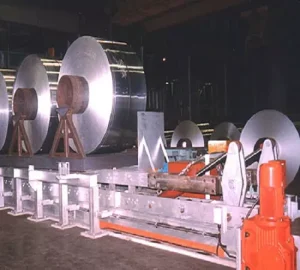
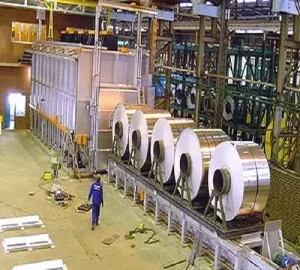
The process begins by loading aluminium coils into the furnace. Depending on the design, this can happen in two common ways. In a fixed hearth system, a charging machine places the coils inside. In a bogie hearth furnace, operators use an EOT crane to position the coils on a movable platform.
From experience, bogie systems are often preferred for heavier loads because they simplify handling and reduce manual effort.
Heating Process and Temperature Control
Once the coils are inside, the furnace starts heating gradually. The heating can be done using:
- Gas-fired radiant tube burners
- Electrical heating elements
What actually happens is that the coils are not directly exposed to flames or elements. Instead, they are heated indirectly through radiant tubes and circulated hot air.
This matters more than people think. Direct heating can create hot spots, while indirect heating ensures uniform temperature across the entire batch.
Role of Air Circulation
Uniform heating does not happen automatically. It depends heavily on airflow inside the furnace.
Efficient recirculation fans push hot air across the coils continuously. In real production, I’ve seen how poor air circulation can ruin an entire batch. The outer layers overheat, while the inner layers remain under-treated.
Modern aluminium coil annealing furnaces use axial or centrifugal fans, sometimes with VFD control, to maintain consistent airflow. This helps achieve better temperature uniformity and faster heat transfer.
Protective Atmosphere Control
Another important aspect is atmosphere control. Aluminium reacts easily with oxygen at high temperatures, which can affect surface quality.
To prevent this, many systems introduce nitrogen gas into the chamber. This creates a protective atmosphere that reduces oxidation.
In practical terms, this means:
- Cleaner surface finish
- Reduced scaling
- Better final product quality
Cooling Stage
After the heating cycle, controlled cooling begins. This stage is just as important as heating.
If cooling happens too quickly or unevenly, internal stresses can return. That defeats the purpose of annealing.
Some systems use forced air cooling with fans, while others rely on natural cooling depending on the process requirement.
Types of Aluminium Coil Annealing Furnaces
Bogie Hearth Annealing Furnace
This design works well for heavy and large batches. The movable bogie allows easy loading and unloading, especially in high-capacity operations.
In many aluminium plants, this setup improves productivity because it reduces downtime between batches.
Fixed Hearth Annealing Furnace
Fixed hearth furnaces are suitable for controlled batch processing where loading systems are already in place. They offer stable operation and are often used where space constraints exist.
Electrically Heated vs Gas Fired Furnaces
Both options have their place in industry.
Gas-fired furnaces offer:
- Faster heating
- Lower operating cost in some regions
Electrically heated furnaces provide:
- Better temperature control
- Cleaner operation
- Easier automation
In real production, the choice depends on energy availability, cost, and process sensitivity.
Key Features That Matter in Real Operation
When evaluating an aluminium coil annealing furnace, a few features make a real difference on the shop floor.
Temperature uniformity is one of the most critical factors. A variation of even a few degrees can affect material properties. High-quality furnaces maintain uniformity within tight limits, ensuring consistent results.
The furnace structure also plays a role. Double-wall construction with proper insulation reduces heat loss and improves energy efficiency. This becomes important in continuous operations where energy cost adds up quickly.
Another aspect is control systems. Modern furnaces use PLC or SCADA-based controls, allowing operators to monitor and adjust parameters easily. From my experience, good control systems reduce human error and improve repeatability.
Where Aluminium Coil Annealing Furnaces Are Used
These furnaces are widely used across industries that depend on aluminium processing.
Cable and conductor manufacturers rely on them to produce flexible and durable conductors. Aluminium coil annealing ensures that wires can be drawn without breaking.
In foil production, annealing improves surface finish and flexibility, which is important for packaging and industrial applications.
Automotive and electrical industries also use annealed aluminium components where strength and flexibility must be balanced.
Practical Challenges and How Furnaces Solve Them
In real production environments, several challenges come up regularly.
One issue is inconsistent heating across large coils. This often happens when airflow is not properly designed. A well-engineered furnace solves this with efficient recirculation systems.
Another challenge is energy consumption. Older furnaces tend to lose heat, increasing operating cost. Modern insulation and controlled heating zones help reduce this problem.
Maintenance is another concern. Systems with easy access to fans, heaters, and components reduce downtime and keep operations running smoothly.
How JR Furnace Approaches This Technology
JR Furnace designs aluminium coil annealing furnaces based on real industrial requirements rather than theoretical assumptions.
The systems are built to handle varying batch sizes, different heating methods, and specific process cycles. From loading systems to atmosphere control, each part of the furnace is designed to improve efficiency and reliability.
In actual operation, the difference shows in consistency. When the furnace performs reliably batch after batch, it reduces rejection rates and improves overall productivity.