
The results of the furnace cycle are frequently used to evaluate heat treatment. Hardness, wear resistance, dimensional stability, and service life can all be impacted by variations in temperature, heating speed, or surface protection, even though a component may appear adequate. Therefore, process control is just as important as final temperature for manufacturers working with demanding metal components.
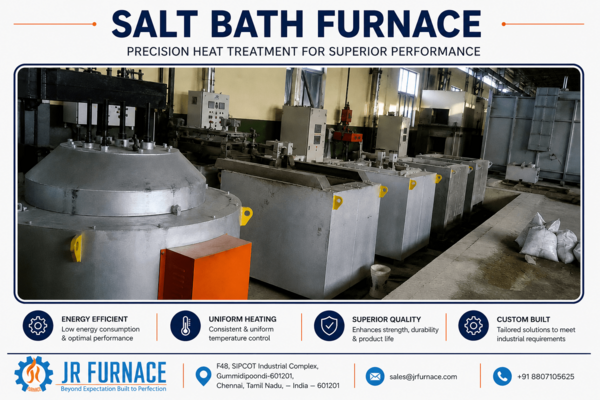
By direct contact with a molten salt media, a Salt Bath Furnace provides a useful method of heating metal components. Heat transfer can be quick and fairly consistent because the heated bath surrounds the workpiece. Because of this, the device is helpful in situations where consistent treatment outcomes and regulated heating are crucial. Therefore, when batch-to-batch consistency is a top concern for production teams, a Salt Bath Furnace may be taken into consideration.
Salt Bath Furnace Applications in Industrial Heat Treatment
A Salt Bath Furnace is widely used for industrial heat treatment where controlled heating, uniform temperature distribution, and consistent results are important. It can be used for processes such as hardening, tempering, annealing, austempering, and martempering. The direct contact between the molten salt and the workpiece allows efficient heat transfer and can help reduce temperature variations during treatment. This makes a Salt Bath Furnace suitable for treating tools, gears, shafts, springs, fasteners, dies, and other engineering components that require reliable and repeatable heat treatment performance.
Why Industries Choose Salt Bath Furnaces for Heat Treatment
Before the heat reaches the workpiece, conventional heating techniques transport heat through air or a regulated environment. The part is submerged straight in the hot media in a salt bath system. The workpiece and the heat source come into close contact as a result.
Fast heat transmission from a Salt Bath Furnace can shorten the time required to raise components to the necessary treatment temperature. Additionally, complicated forms are surrounded by molten salt, which helps heat reach areas that could be challenging to heat uniformly using other techniques.
Surface protection is another helpful function. The bath can lessen direct oxygen exposure and assist prevent oxidation and scaling, depending on the salt’s composition and treatment. Less post-treatment cleaning or finishing labor may result from cleaner surfaces.
How the Procedure Produces Reliable Outcomes
The proper salt composition and operation temperature are the first steps toward consistency. Throughout manufacturing, the bath’s condition should be observed and it must be kept within the designated working range. Process performance can be altered by contamination, moisture, or an improper salt mixture.
Heat is transferred from the molten salt to the metal when a component is placed in a Salt Bath Furnace. The part is kept for the predetermined amount of time after the necessary temperature is obtained. Depending on the material and necessary characteristics, it can then be withdrawn for quenching or the subsequent phase of the treatment cycle.
Accurate temperature measurement is crucial. Employing appropriate sensors and routinely comparing the temperature of the furnace to the actual bath conditions are important for operators. This facilitates improved control over hardness and other material qualities and lessens batch-to-batch fluctuations.
Industrial Heat Treatment Applications
Steels and other appropriate alloys can undergo a variety of heat treatment processes in a Salt Bath Furnace. Depending on the salt system and equipment design, common uses include hardening, tempering, annealing, austempering, martempering, and stress-related treatments.
Tools, shafts, gears, fasteners, springs, dies, cutting pieces, and other engineering components can all benefit from this technique. When a factory needs controlled heating for repeated batches instead of sporadic workshop heating, it is very appealing.
The bath’s direct contact can also be useful for smaller or more complex components. Compared to a traditional air-heating system, parts with corners, grooves, or uneven profiles might receive more consistent heating.
Advantages for Surface Quality
After heat treatment, surface condition is a crucial factor. Scale can be produced by excessive oxidation, which also raises the need for cleaning, grinding, or finishing. The surface of the workpiece can be shielded from heat by a well-managed bath.
When the salt is properly chosen and maintained, a Salt Bath Furnace can also offer a direct and clean heating environment. For parts where dimensions accuracy and surface polish are crucial, this can be helpful.
However, the furnace is not the only factor that affects surface quality. The final outcome is influenced by a number of factors, including salt condition, immersion time, temperature, handling, quenching technique, and cleaning following treatment.
Crucial Elements for Selecting the Equipment
Manufacturers should take into account the type of material being treated, the necessary temperature range, batch size, component dimensions, manufacturing volume, and treatment cycle before choosing a Salt Bath Furnace.
The size and number of components should be compatible with the salt pot’s capacity. Even when components are added to the bath, the heating capacity must be adequate to sustain the necessary temperature. Temperature management should be reliable, simple to keep an eye on, and appropriate for the necessary process tolerances.
Additionally, safety features should be carefully considered. Certain salt systems need to be handled carefully, and molten salts function at high temperatures. Thus, proper insulation, controls, ventilation, lifting provisions, and operator protection should all be included in furnace design.
Another important factor is the choice of salt. Different salt formulas may be needed for different applications and treatment temperatures. The workpiece material and the planned heat treatment procedure should be compatible with the chosen system.
Upkeep and Process Management
A Salt Bath Furnace can be kept dependable during extended production periods with routine maintenance. In accordance with the guidelines provided by the equipment manufacturer, operators should examine heating elements, temperature sensors, electrical controls, refractory or insulation, bath condition, and mechanical components.
It is also important to keep an eye out for contamination and compositional changes in the salt. Surface quality and heating efficiency might be impacted by poor bath conditions. It can be simpler to spot process changes before they become production issues by keeping track of temperature, treatment duration, salt condition, and inspection findings.
When operating a Salt Bath Furnace, standard operating procedures are equally crucial. Variation between operators and batches can be minimized by using consistent loading, immersion depth, holding time, and quenching procedures.
Why Manufacturers Care About Process Consistency
Repeatability directly affects quality control in a production unit. Even when the same material is used, hardness and mechanical qualities may differ if one batch is subjected to a different heat cycle than another.
A well-managed Salt Bath Furnace can facilitate consistent heating conditions and facilitate the standardization of process parameters. Manufacturers who produce vast quantities of similar components will find this extremely helpful.
Reaching a specific temperature is not the only objective. From preheating and immersion to holding, quenching, and post-treatment cleaning, the entire cycle needs to be managed. The ultimate characteristics of the component might be influenced by each stage.
Conclusion
For industrial heat treatment applications where quick heat transmission, regulated heating, surface protection, and consistent outcomes are crucial, a Salt Bath Furnace can be a helpful option. It is appropriate for a wide range of engineering components and manufacturing settings because to its direct-contact heating process.
Manufacturers should choose the appropriate salt system, maintain precise temperature control, keep an eye on bath conditions, and adhere to standard operating procedures for optimal outcomes. The procedure can assist enhance surface quality and lessen variation between heat treatment batches when these variables are appropriately controlled.
FAQ
1. What is the purpose of a salt bath furnace?
Metal components are heated in a Salt Bath Furnace for controlled heat treatment procedures like hardening, tempering, annealing, and austempering.
2. Is surface quality enhanced by a salt bath furnace?
When the proper salt system and operating conditions are maintained, it can aid in reducing oxidation and scaling during heating. Quenching, cleaning, and overall process control all affect the final surface quality.
3. What kinds of materials are suitable for treatment in a salt bath furnace?
The salt chemistry, operation temperature, and treatment procedure all affect the appropriate materials. When the furnace and salt system are made specifically for them, steels and other engineering alloys can be treated.
4. What should be examined before purchasing a salt bath furnace?
Take into account the necessary temperature range, bath capacity, component size, manufacturing volume, heating capacity, accuracy of temperature control, safety precautions, compatibility with salt, and maintenance needs.