
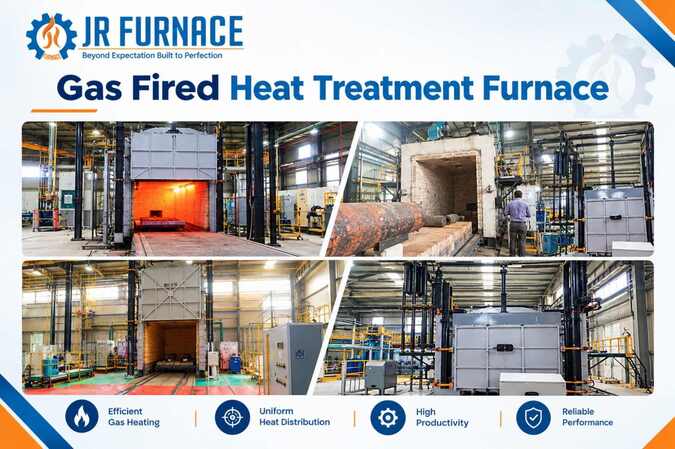
An essential piece of machinery for businesses that frequently require the controlled heating of metals is a gas-fired heat treatment furnace. The furnace uses a regulated burner system to burn fuel, such as natural gas or LPG, in place of electrical heating elements.
The type of material being processed, furnace size, production volume, necessary temperature, fuel availability, and general operating circumstances all play a role in the heating method selection for many manufacturing facilities. When significant heating capacity is needed for huge industrial loads, gas-fired systems can be especially helpful.
However, picking a furnace involves more than just picking a chamber and a gas burner. Consistent temperature, appropriate heat circulation, safe combustion, sufficient insulation, and dependable process management are all requirements for the furnace.
What Is a Gas Fired Heat Treatment Furnace?
A Gas Fired Heat Treatment Furnace is an industrial furnace designed to heat metal components using gas as the primary source of thermal energy.
The generated heat is transferred into the furnace chamber, where components are heated according to a predetermined temperature cycle. Depending on the material and treatment required, the process may involve heating, soaking and controlled cooling.
Gas-fired furnaces can be designed in different configurations depending on the application. For example, manufacturers may use batch-type systems for varied production requirements or continuous furnaces where components need to move through several controlled heating zones.
The important thing is that the furnace should be designed around the actual process rather than using the same configuration for every application.
How Does a Gas Fired Heat Treatment Furnace Work?
The working principle is relatively straightforward, but achieving uniform heat treatment requires careful engineering.
1. Loading the Components
The components are placed inside the furnace chamber. Loading arrangements depend on the size, weight and shape of the parts.
Large fabricated structures may require a bogie hearth arrangement, while smaller components may be processed in chamber or continuous furnace systems.
2. Fuel Combustion
In a Gas Fired Heat Treatment Furnace, proper burner control helps maintain stable combustion and supports consistent heating throughout the process.
3. Heating
Once the burners are operating, heat is transferred into the furnace chamber.
The temperature is gradually raised according to the required heat treatment cycle. Temperature sensors and controllers continuously monitor the chamber conditions.
4. Soaking
Reaching the required temperature is only part of the process.
The components may need to remain at the specified temperature for a particular period. This soaking stage allows the heat to penetrate the components and helps achieve a more uniform treatment.
The required soaking time depends on factors such as material grade, component thickness, load arrangement and the heat treatment specification.
5. Controlled Cooling
After the required heating and soaking cycle is completed, the components are cooled according to the process requirement.
Depending on the application, cooling may take place inside the furnace, through controlled air circulation or through a separate cooling or quenching arrangement.
The cooling method used in a Gas Fired Heat Treatment Furnace should be selected according to the material, component geometry and required metallurgical properties.
Why Is Temperature Uniformity Important?
Temperature uniformity is one of the most important factors in any industrial heat treatment process.
Imagine placing several large steel components inside a furnace. If one area of the chamber is significantly hotter than another, different parts of the same load may experience different thermal cycles.
This can lead to inconsistent results.
A properly designed Gas Fired Heat Treatment Furnace therefore needs suitable burner positioning, heat circulation, insulation and temperature monitoring.
For large furnaces, circulation systems and air-flow arrangements can help distribute heat more evenly throughout the working chamber. JR Furnace’s existing industrial furnace documentation also describes recirculation fans, air-guide arrangements and gas-fired heating options for heavy-duty furnace designs.
Common Heat Treatment Processes Using Gas-Fired Furnaces
A gas-fired system can be configured for several industrial heat treatment applications, depending on the furnace design and process requirements.
Annealing
In annealing, a material is heated to a predetermined temperature and then carefully cooled. It can be used to change the structure of metals, decrease internal tensions, and increase machinability.
Stress Relieving
A Gas Fired Heat Treatment Furnace can be configured for stress-relieving applications when the required temperature range, load size and heating cycle are properly defined.
JR Furnace also offers furnace systems for stress-relieving applications, with gas-fired heating among the available heating options.
Normalizing
Normalizing is commonly used for steel components where controlled heating and air cooling are required to obtain the desired structure and mechanical properties.
Hardening
Hardening involves heating steel to a suitable temperature followed by rapid cooling. The exact cycle depends on the material and required hardness.
Tempering
Tempering is generally performed after hardening. The process reheats the hardened component to a controlled temperature to improve toughness and reduce excessive brittleness.
Post Weld Heat Treatment
Large welded structures, pressure vessels, fabricated components and similar products may require controlled post-weld heat treatment to reduce residual stresses and meet process requirements.
Where Are Gas Fired Heat Treatment Furnaces Used?
A Gas Fired Heat Treatment Furnace can be used in industries where large metal components or high production loads require controlled thermal processing.
Typical applications include:
- Automotive component manufacturing
- Steel processing
- Heavy engineering
- Forging
- Foundry operations
- Fabrication
- Pressure vessel manufacturing
- Tool and die manufacturing
- General engineering
- Oil and gas equipment manufacturing
The correct furnace configuration depends on the component size, material, production volume and heat treatment cycle.
Advantages of a Gas Fired Heat Treatment Furnace
Gas-fired heating can provide several practical benefits for suitable industrial applications.
High Heating Capacity
The heating capacity of a Gas Fired Heat Treatment Furnace can be selected according to the chamber size and thermal load required by the production process.
Suitable for Large Components
Large components often require considerable thermal energy. A properly designed gas-fired system can be configured around these requirements.
Flexible Furnace Design
Gas-fired heating can be incorporated into different furnace configurations, including batch and continuous systems.
Suitable for Heavy-Duty Production
Manufacturing plants processing large quantities of metal components can consider gas-fired systems where the available fuel infrastructure and production requirements make them suitable.
Process Automation
Modern furnace systems can incorporate temperature controllers, PLCs, HMI interfaces, data monitoring and other automation features. JR Furnace describes PLC-based control and SCADA/HMI integration within its industrial heat-treatment systems.
Gas Fired vs Electric Heat Treatment Furnace
There is no single heating method that is suitable for every manufacturing plant.
A gas-fired furnace may be considered when high heating capacity, large loads and available gas infrastructure are important factors.
An electric furnace may be attractive when clean heating, precise temperature control and the available electrical infrastructure suit the application.
The choice should be based on:
- Required operating temperature
- Component dimensions
- Batch weight
- Production volume
- Heating cycle
- Temperature uniformity
- Available fuel or electricity
- Automation requirements
- Furnace installation space
- Operating and maintenance requirements
The objective should be to select the heating system that matches the complete production process rather than choosing solely on the initial equipment cost.
Important Features to Consider Before Buying
Before selecting a Gas Fired Heat Treatment Furnace, manufacturers should discuss the complete process with the furnace supplier.
Furnace Capacity
Determine the maximum load weight and dimensions that need to be processed.
Temperature Requirement
The furnace should be designed around the actual operating temperature rather than simply selecting the highest possible temperature.
Burner System
The burner arrangement affects heating performance, combustion and temperature distribution.
Insulation
Good insulation helps reduce unnecessary heat loss and can improve thermal efficiency.
Temperature Control
Reliable thermocouples, controllers and monitoring systems are essential for maintaining the required heating cycle.
Safety Systems
Proper safety engineering is particularly important in a Gas Fired Heat Treatment Furnace because the system handles fuel, combustion and high operating temperatures.
Loading Method
The loading arrangement should match the component size and weight. Large components may require a bogie or other mechanical handling system.
Automation
For production environments, PLC, HMI and data-monitoring systems can make process management easier and provide better control over repeatability.
How to Choose the Right Gas Fired Furnace
When selecting a Gas Fired Heat Treatment Furnace, manufacturers should also consider future production requirements so that the equipment can support expected changes in workload.
Start by identifying the material being treated. Then determine the required heat treatment process, operating temperature, component dimensions, batch weight and expected production rate.
Next, consider how the components will be loaded and unloaded. This becomes especially important for heavy or oversized components.
The furnace manufacturer should then evaluate burner capacity, chamber dimensions, insulation, temperature-control requirements, circulation, automation and safety systems.
A customized design may be more appropriate than a standard furnace when the component geometry or production cycle is unusual.
Why Furnace Design Matters
A furnace may reach the required temperature and still fail to deliver consistent heat treatment if the temperature distribution inside the chamber is poor.
That is why furnace design needs to consider the entire thermal cycle.
Burner location, chamber dimensions, insulation thickness, airflow, circulation, door sealing and control systems all have an effect on furnace performance.
For example, JR Furnace’s heavy-duty furnace designs include gas-fired heating options, ceramic-fibre or refractory insulation, temperature-uniformity specifications and PLC-based automation depending on the configuration.
Gas Fired Heat Treatment Furnace from JR Furnace
JR Furnace & Ovens manufactures industrial furnace and heat treatment systems for different manufacturing requirements. Its product range includes gas-fired furnaces along with electric, oil-fired and other specialized furnace configurations.
The company designs furnace systems around factors such as temperature, load capacity, material, production requirements and required process control.
For industries considering a Gas Fired Heat Treatment Furnace, providing complete process information to the furnace manufacturer is an important first step. This allows the furnace design to be matched more closely to the actual production requirement.
Conclusion
For enterprises that need to manage the heating of massive components, heavy loads, or large production batches, a gas-fired heat treatment furnace may be a workable alternative.
The gasoline used is not the only factor that affects its performance. Reliable operation is influenced by a number of factors, including the choice of burner, temperature consistency, insulation, circulation, automation, loading configurations, and safety systems.
Manufacturers should specify the material, component size, batch weight, heat treatment cycle, production volume, and temperature requirements before making a furnace investment. Instead of depending on a general configuration, the furnace may be tailored around the real process thanks to these specifics.
JR Furnace & Ovens offers furnace systems made for various heat treatment and industrial processing needs to businesses seeking a specialized industrial heating solution.
FAQ
- What is a furnace used for gas-fired heat treatment?
An industrial heating system called a gas-fired heat treatment furnace employs fuel, such as natural gas or LPG, to produce heat for carefully regulated metal component treatment.
- Which heat treatment procedures can make use of a gas-fired furnace?
Gas-fired systems can be used for annealing, normalizing, stress relief, hardening, tempering, and post-weld heat treatment, depending on the furnace layout.
- Can huge components be burned in a gas-fired furnace?
Yes. Large chambers and huge loads can be accommodated in gas-fired systems. Component dimensions, batch weight, temperature requirements, and manufacturing volume all influence the proper configuration.