
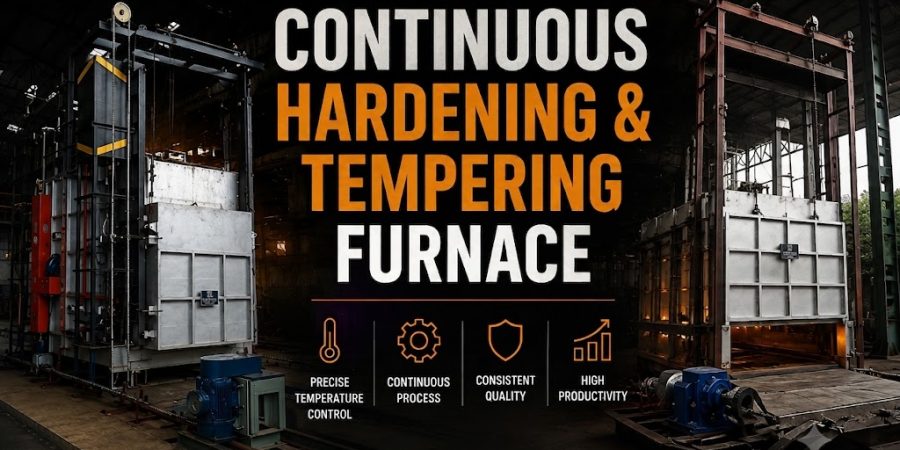
A continuous heat treatment line is built for one main purpose: moving components through a controlled sequence of heating, hardening, cooling and tempering without stopping production. This makes continuous systems useful when a manufacturer handles large quantities of similar parts and needs consistent results from batch to batch.
A continuous hardening and tempering furnace combines two important stages of heat treatment in a connected production setup. Instead of loading and unloading every batch separately, components can move through the required heating zones at a controlled speed. The result is a steady process that can suit automotive, engineering, fastener, bearing and other metal component manufacturing.
What Is a Continuous Hardening and Tempering Furnace?
It is an industrial heat-treatment system designed to process components continuously. Parts enter the heating section, reach the required hardening temperature, undergo quenching, and then move toward the tempering section. Depending on the line design, washing, atmosphere control, cooling and material handling equipment may also be included.
The main advantage is process continuity. In a batch furnace, operators generally load a group of parts, complete the cycle, unload them and prepare the next batch. A continuous hardening and tempering furnace reduces these repeated handling steps by keeping material moving through defined stages.
How Does the Process Work?
The exact sequence depends on the material, component size and required mechanical properties, but the basic process is easy to understand.
First, components are heated to a controlled temperature suitable for hardening. The furnace must provide uniform heat so that parts receive consistent treatment. Temperature, conveyor speed and atmosphere are monitored because small process variations can affect the final properties.
After heating, the components are transferred to the quenching stage. Quenching cools the heated material rapidly using a suitable medium. This changes the structure of the steel and increases hardness. The choice of quenching method depends on the material and the production requirement.
Hardening can produce a strong but relatively brittle structure. Tempering is therefore carried out afterward to reduce excessive brittleness and improve the balance between hardness, toughness and strength.
In a continuous hardening and tempering furnace line, the tempering stage is arranged so that components can move through the process without unnecessary interruption. The tempering temperature and holding time are selected according to the required properties of the finished part.
Why Is Continuous Processing Useful?
Continuous processing becomes valuable when production volumes are high and components need repeatable heat treatment. A continuous hardening and tempering furnace can help maintain a regular production flow while reducing manual handling between stages.
It can also make process control easier. When conveyor speed, furnace temperature and treatment time are properly established, each component follows a defined path. This can improve consistency across production runs.
Another advantage is production planning. A continuous line can be integrated with upstream forming, machining or washing operations and downstream inspection or finishing. For manufacturers producing large numbers of similar components, this type of arrangement can reduce idle time.
Which Components Can Be Treated?
The equipment can be used for many steel components where hardening and tempering are required. Typical examples include gears, shafts, pins, fasteners, automotive components, bearing parts and various engineered steel components.
The suitable process is not the same for every component. Material grade, section thickness, shape, required hardness and production volume all influence the furnace design and operating parameters.
For example, a small fastener line may require a different conveyor arrangement and heating capacity from a system designed for larger shafts or automotive parts. This is why the component specification should be considered before selecting a continuous hardening and tempering furnace.
Important Factors When Selecting a Furnace
Furnace selection should begin with the parts being processed rather than simply the furnace size. Production rate is one of the first factors to consider. The system needs enough capacity to handle the required number of components per hour while maintaining the necessary heating and treatment time.
Temperature uniformity is another important consideration. Uneven heating can lead to inconsistent results, especially when components have different cross-sections.
The quenching arrangement also matters. The quenching medium, circulation, temperature control and transfer time can influence the final properties of the component.
Atmosphere control may be required for applications where surface condition and oxidation need to be controlled. Proper loading and material movement are equally important because overcrowding can affect heating and cooling.
A well-designed continuous hardening and tempering furnace should also be considered from the maintenance and operating side. Easy access to heating elements, burners, fans, controls and other service areas can make routine maintenance more practical.
Energy use is another point worth evaluating. Furnace insulation, heating method, recovery systems, operating temperature and production loading all influence energy consumption. A system that is correctly sized for the actual workload can avoid unnecessary heating capacity.
How Does Automation Improve the Process?
Automation can control material movement, furnace temperature, quenching conditions and tempering cycles. Sensors and control systems can help operators monitor the process and identify deviations.
In a continuous hardening and tempering furnace, automation is especially useful because production is moving continuously. A stable conveyor speed helps maintain the required residence time in each zone. Data logging can also support quality checks and process records where required by the application.
However, automation does not replace good process engineering. The correct temperature, time, atmosphere and quenching conditions still need to be established according to the material and component requirements.
Continuous vs. Batch Heat Treatment
Both continuous and batch furnaces have their place in industry. Batch systems are useful when parts vary considerably in size, material or treatment cycle, or when production quantities are smaller.
Continuous systems are generally more suitable when the same or similar components are processed in larger quantities. A continuous hardening and tempering furnace can provide a smoother production flow and reduce repeated loading and unloading.
The right choice depends on production volume, component geometry, required cycle, available floor space, quality requirements and the level of automation desired.
Applications in Industry
Continuous hardening and tempering furnace systems are commonly considered for industries where large numbers of metal components require repeatable mechanical properties. Automotive and auto-component manufacturing is one important area, along with fastener production, bearing manufacturing, general engineering and other component industries.
In these applications, the objective is not simply to make a part harder. The heat-treatment cycle must produce the right combination of hardness, strength and toughness for the component’s working conditions.
What Should Buyers Discuss With a Furnace Manufacturer?
Before ordering equipment, buyers should provide clear information about material grade, component dimensions, weight, required hardness, production rate and expected operating hours. Details about loading method and available space are also useful.
A furnace manufacturer can then evaluate heating capacity, conveyor arrangement, quenching system, tempering zones, atmosphere requirements, controls and safety features.
For this type of continuous heat-treatment line, it is particularly important to discuss the complete line rather than only the heating chamber. Transfer time between stages, quenching performance and tempering residence time can all affect the final result.
JR Furnace & Ovens (P) Ltd designs industrial furnace and oven systems for heat-treatment applications. For manufacturers considering a continuous hardening and tempering furnace, discussing the component and production requirements with the furnace manufacturer is a practical first step.
Conclusion
A continuous hardening and tempering furnace can be a strong choice for manufacturers that need steady production, repeatable heat treatment and reduced manual handling. By combining controlled heating, quenching and tempering in a continuous line, the system can support large-volume production of engineered metal components.
The best furnace is not simply the one with the highest capacity. It should match the material, component geometry, production rate, required properties and operating conditions. Careful process planning at the design stage helps ensure that the furnace supports both production needs and consistent component quality.
Frequently Asked Questions
1. What is the main purpose of a continuous hardening and tempering furnace?
Its main purpose is to continuously heat, harden, quench and temper metal components while maintaining controlled process conditions and steady production.
2. What industries use continuous hardening and tempering furnaces?
They are commonly used for automotive components, fasteners, bearings, gears, shafts, pins and other steel parts produced in medium to high volumes.
3. Is continuous heat treatment better than batch heat treatment?
Neither is universally better. Continuous systems are generally useful for higher-volume production of similar components, while batch furnaces offer greater flexibility for varied parts and smaller production runs.
4. What information is needed to select a continuous hardening and tempering furnace?
Important information includes material grade, component size and weight, production rate, required hardness, heat-treatment cycle, quenching requirements and available installation space.