
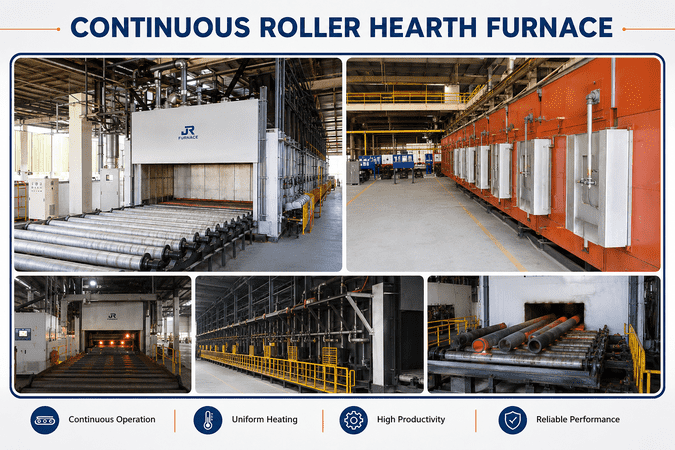
A roller hearth furnace is a type of industrial heating system that keeps materials moving through different heat zones using rotating rollers.It’s different from batch furnaces, where items are placed in, heated, and taken out all at once.In this, products move continuously through the furnace, passing through various temperature areas.
This kind of furnace is especially helpful for businesses that need to heat a lot of parts regularly.
It helps ensure the temperature stays consistent, the heating process is controlled, and the same steps are followed every time.
Depending on what the business needs, a Roller Hearth Heating Furnace can be used for different heat treatments, like annealing, normalizing, hardening, stress relief, tempering, brazing, and more.
For companies working with big or heavy parts, choosing the correct furnace design is important.
Factors like the size of the parts, how fast they need to be processed, the required temperature, the type of atmosphere inside, the material being used, and the specific heat treatment process can all affect how well the furnace works.
What Is a Roller Hearth Furnace?
A roller hearth furnace is a type of continuous furnace where parts are carried through the heating area on a set of powered rollers.These rollers help move the parts from the area where they are put in, through different heating sections, and finally to where they are taken out.The furnace can have several sections, each kept at a certain temperature based on what’s needed for the process.
The way it works is simple:
Putting in parts → Rollers move → Heating → Holding at heat → Cooling or more treatment → Taking out parts
Because the parts keep moving through the furnace, this kind of setup works well in places where having a steady flow of materials is better than handling small batches one after another.
The design of the furnace can be changed depending on the type and size of the parts being processed.
How Does a Roller Hearth Furnace Work?
The Continuous Roller Furnace working principle is based on controlled movement and controlled heating.
Components are placed onto the rollers at the charging end. The rollers rotate at a controlled speed and gradually move the components through the furnace.
Inside the furnace, heating is divided into one or more temperature zones. Each zone can be controlled independently to achieve the required heating cycle.
For example, a typical heat treatment process may include:
Preheating – The component is gradually brought toward the required process temperature.
Heating – The temperature is increased to the specified treatment temperature.
Soaking – The component remains within the required temperature range long enough for uniform heating throughout its section.
Cooling or further processing – Depending on the process, the component may move to a cooling, quenching, or subsequent treatment section.
Discharge – The treated component exits the furnace for inspection or the next manufacturing operation.
The roller speed is an important parameter because it determines how long the component remains inside each zone. Temperature controllers, thermocouples, drives, and other control systems work together to maintain consistent process conditions.
For production facilities, this controlled movement can help maintain a more predictable cycle than manually operated batch processing.
Main Components of a Roller Hearth Furnace
It consists of several systems that work together to provide controlled and continuous heating.
1. Rollers
The rollers carry the components through the furnace. Their material, diameter, spacing, and construction are selected according to the operating temperature and the weight and shape of the workpieces.
Roller design is especially important when processing heavy components because the rollers must withstand both thermal conditions and mechanical loads.
2. Heating Chamber
The heating chamber is the main enclosed area where the heat treatment process takes place. Its size and internal arrangement depend on the required production capacity and component dimensions.
3. Heating System
The furnace may use electric heating elements or fuel-fired burners. The heating arrangement is selected based on temperature, atmosphere, production requirements, and operating preferences.
4. Temperature Control System
Temperature sensors and controllers monitor the furnace temperature in different zones. Proper temperature control is essential when consistent metallurgical results are required.
5. Refractory and Insulation
Refractory materials and insulation help retain heat inside the furnace while protecting the furnace structure from high temperatures.
Good insulation can also reduce unnecessary heat loss and contribute to more efficient furnace operation.
6. Drive Mechanism
The drive system controls roller rotation and therefore controls the movement of components through the furnace. Variable speed control can be useful when different process cycles require different residence times.
7. Loading and Unloading System
Depending on the application, loading and unloading can be manual, semi-automatic, or integrated with material-handling equipment.
Types of Roller Hearth Furnaces
The exact furnace configuration depends on the required process and production environment.
Electric
It uses electrical heating elements to generate and control heat. These furnaces can provide accurate temperature control and are suitable for applications where a clean and controlled heating environment is required.
Gas-Fired
Fuel-fired designs use burners to generate heat inside the furnace. They can be considered for applications requiring high heating capacity and continuous industrial production.
Heat Treatment
These furnaces are configured specifically for processes such as annealing, normalizing, hardening, tempering, or stress relieving.
The design may include additional sections for quenching, cooling, atmosphere control, or other process requirements.
Continuous
It is designed for uninterrupted or high-volume production. Components enter at one end and move continuously through the required processing zones.
This configuration is particularly useful when production volume and repeatability are important.
Applications of Roller Hearth Furnaces
Common applications include:
- Heat treatment of steel components
- Annealing of metal products
- Normalizing of components
- Stress relieving
- Hardening and tempering operations
- Brazing and controlled-atmosphere heating
- Processing of automotive components
- Treatment of fabricated metal parts
- Processing of tubes, bars, plates, and similar components
- High-volume industrial heat treatment
The exact application depends on the furnace temperature, component geometry, material, atmosphere, production rate, and required metallurgical properties.
Advantages of a Roller Hearth Furnace
One of the biggest advantage is its ability to support continuous production.
Continuous Material Flow
Components can move through the furnace without the repeated loading and unloading associated with batch processing.
Better Production Efficiency
For high-volume operations, continuous movement can reduce handling time and help maintain a steady production flow.
Controlled Heating
Multiple heating zones allow the process to be controlled according to the required temperature profile.
Consistent Processing
When roller speed, temperature, and other process parameters are properly controlled, components can receive a more repeatable heat treatment cycle.
Suitable for Heavy Components
With appropriate roller and furnace construction, the system can be designed for relatively heavy industrial components.
Customizable Design
It can be engineered according to component dimensions, production capacity, temperature requirements, heating method, and heat treatment process.
Roller Hearth Furnace vs. Batch Furnace
The choice between a continuous roller hearth furnace and a batch furnace depends mainly on the production requirements.
A batch furnace is generally suitable when different products are processed in smaller quantities or when individual batch cycles are preferred.
In simple terms:
| Feature | Roller Hearth Furnace | Batch Furnace |
| Production method | Continuous | Batch |
| Material movement | Through rollers | Loaded as a batch |
| High-volume production | Highly suitable | Less suitable in many cases |
| Process flexibility | Moderate to high | Generally high |
| Material handling | Continuous movement | Loading/unloading between cycles |
| Best suited for | Repetitive production | Variable or smaller batches |
The right choice should always be based on production volume, component geometry, heat treatment requirements, available space, and operating cost.
How to Choose the Right Roller Hearth Furnace
Basically it should not be based only on furnace size or maximum temperature.
Several technical factors should be evaluated before finalizing the design.
Component Size and Weight
The dimensions and weight of the workpieces determine the required roller arrangement, chamber dimensions, and mechanical design.
Required Temperature
Different materials and heat treatment processes require different operating temperatures. The furnace should provide sufficient temperature capability with appropriate control.
Production Capacity
Determine how many components need to be processed per hour or per day. This helps establish the required furnace length, roller speed, and heating capacity.
Heating Method
Electric and fuel-fired systems have different operating characteristics. The choice should consider energy availability, temperature requirements, atmosphere, operating costs, and plant conditions.
Atmosphere Requirements
Some applications require controlled or protective atmospheres to reduce oxidation, scaling, or unwanted surface reactions.
Cooling and Quenching Requirements
If the process includes rapid cooling or quenching, the furnace may need to be integrated with a suitable cooling or quenching system.
Automation
For higher production volumes, automatic loading, unloading, temperature monitoring, roller-speed control, and process data recording can improve process management.
Why Work With an Experienced Roller Hearth Furnace Manufacturer?
A furnace is not simply a heated chamber with rollers. Its performance depends on the interaction between mechanical design, heating capacity, temperature control, insulation, material handling, and the specific heat treatment cycle.
An experienced roller hearth furnace manufacturer can evaluate the application and develop a furnace configuration around the actual production requirements.
Before selecting a manufacturer, it is useful to discuss:
Component dimensions and weight
Material grade
Required heat treatment
Operating temperature
Production capacity
Heating method
Atmosphere requirements
Cooling or quenching requirements
Automation level
Available installation space
Providing these details helps the manufacturer determine a suitable furnace configuration instead of offering a generic design.
Roller Hearth Furnace for Industrial Heat Treatment
For industries where components need to be processed repeatedly and consistently, it can provide an effective alternative to conventional batch processing.
Its continuous material movement, controlled heating zones, adjustable residence time, and customizable configuration make it suitable for a wide range of industrial applications.
However, furnace selection should always be based on the actual process rather than simply choosing the highest temperature or largest capacity available. A correctly designed furnace can provide better process control, smoother production flow, and more predictable operating performance.
Conclusion
A roller hearth furnace can be a good choice for manufacturers who need steady and controlled industrial heating.
It moves materials using rollers, has different temperature areas, and can be set up in many ways to fit various heat treatment and thermal processing needs.
However, the best furnace isn’t always the biggest or strongest one.
The best one is the one that’s made to fit the specific part, how fast it needs to produce, the required temperature, and the overall process needs.
For companies planning to install a new furnace or upgrade their existing heat treatment system, talking to a skilled expert can help find the right setup for dependable and efficient operation.
Frequently Asked Questions
What is a roller hearth furnace used for?
It is used to continuously heat and perform heat treatment on industrial parts.
Also used for processes like annealing, normalizing, hardening, tempering, stress relief, brazing, and other heating treatments that need precise temperature control.
How does a roller hearth furnace work?
Items are put on moving rollers and moved through different areas with specific temperatures.
The speed of the rollers and the heating process are controlled to match the needs of the heat treatment.
What industries use Continuous Hearth Furnace?
Industries like automotive, engineering, metalworking, fabrication, and other manufacturing sectors use Continuous Hearth Furnace when they need continuous or high-volume thermal processing.
Can a roller hearth furnace be customized?
Yes.
The size of the furnace, the roller setup, the heating method, the temperature zones, the atmosphere system, cooling setup, automation, and how materials are handled can all be tailored to fit the specific application.