
Metal components often pass through several manufacturing processes such as welding, machining, forming, casting, rolling, and fabrication before becoming finished products. While these operations are essential for producing strong and precise components, they can also create internal stresses within the metal.
If these residual stresses are not properly controlled, they may affect dimensional accuracy, machining performance, stability, and the overall reliability of a component. This is where stress relieving heat treatment becomes an important part of metal manufacturing.
It is a controlled thermal process designed to reduce residual stresses in metal components while maintaining their basic structure and mechanical properties. For manufacturers working with welded structures, heavy fabrications, machinery parts, and precision components, an appropriate stress relief process can help make subsequent manufacturing operations more predictable.
What Is Stress Relieving Heat Treatment?
Stress relieving heat treatment involves heating a metal component to a controlled temperature, holding it at that temperature for a specified period, and then cooling it under controlled conditions.
The objective is generally not to change the fundamental structure of the material. Instead, controlled heating allows internal stresses that developed during manufacturing to relax.
Residual stresses can occur when different sections of a component heat, expand, cool, or contract at different rates. Welding is a common example. During welding, a small area is exposed to intense heat while the surrounding material remains comparatively cooler. As the welded area cools, uneven expansion and contraction can leave stresses locked inside the component.
Machining, forging, casting, rolling, bending, and forming can also contribute to residual stress.
With the right thermal cycle, manufacturers can reduce these stresses and improve the dimensional stability of the finished component.
Why Do Metal Components Develop Residual Stress?
Residual stress can be introduced at different stages of manufacturing. Common causes include:
- Welding and fabrication
- Machining and cutting
- Forging and forming
- Casting
- Rolling and bending
- Rapid heating and cooling
- Uneven material thickness
- Differences in cooling rates
- Localized heating during manufacturing
A component can appear completely normal from the outside while still containing significant internal stresses. These stresses may become noticeable when the component is machined, assembled, reheated, or exposed to service loads.
For example, consider a large welded steel component that requires precision machining. Material removal can allow previously locked-in stresses to redistribute, potentially causing the component to move or distort.
Applying stress relieving heat treatment before critical machining can help reduce the possibility of unexpected dimensional changes and improve the stability of the component during subsequent processing.
The Process of Stress Relieving Heat Treatment
The effectiveness of the process depends on carefully controlling the complete thermal cycle rather than simply heating the component to a particular temperature.
1. Controlled Heating
The component is gradually heated to a predetermined temperature. The heating rate should be selected according to the material, thickness, geometry, and condition of the component.
Controlled heating is particularly important for large or complex components because rapid or uneven heating can introduce additional thermal stresses.
2. Holding at the Required Temperature
Once the required temperature is reached, the component is held for a specified period. This holding stage gives the material sufficient time for internal stresses to relax.
The required temperature and holding duration can vary depending on material composition, component thickness, geometry, manufacturing history, and applicable process requirements.
3. Controlled Cooling
After the holding stage, the component is cooled under controlled conditions.
Cooling is an important part of stress relieving heat treatment because excessive cooling rates can create new thermal stresses. The cooling method should therefore be selected according to the material and component design.
The complete cycle should be developed for the specific application instead of applying identical settings to every component.
What Is the Role of Stress Relieving in Metal Manufacturing?
The primary purpose of stress relieving is to improve the dimensional and structural stability of manufactured components.
When residual stresses are reduced, manufacturers can often achieve more predictable results during machining, fabrication, assembly, and other subsequent operations.
For example, a large fabricated structure may undergo extensive welding before machining. If substantial residual stresses remain, machining can cause the component to move as internal stresses redistribute. A suitable stress relief cycle before machining can help minimize this risk.
This is particularly valuable when components require tight dimensional tolerances or need to maintain their shape during later processing.
Stress relieving heat treatment can therefore be an important consideration for manufacturers producing heavy fabrications, precision components, and industrial equipment.
Stress Relieving of Steel Components
Steel is widely used in industrial machinery, fabricated structures, heavy equipment, pressure-related components, and engineering applications. Many of these components involve welding, forming, or machining processes that can introduce residual stresses.
Stress relieving heat treatment for steel can help reduce these locked-in stresses before a component moves to its next manufacturing stage or enters service.
The exact treatment depends on the grade of steel and the component’s design. Factors such as thickness, geometry, welding procedure, previous thermal processing, and required dimensional accuracy should be considered when establishing the process.
For this reason, stress relieving should be treated as an engineered thermal process rather than simply heating a component to a fixed temperature.
Stress Relieving After Welding
Welding is one of the most common manufacturing processes associated with residual stress.
During welding, localized heating causes the metal near the weld to expand. As the weld cools and contracts, the surrounding material can restrict this movement. This can leave residual stresses within and around the welded area.
For large welded fabrications, these stresses can influence dimensional stability and machining behavior.
A properly designed stress relieving heat treatment cycle can help reduce residual stresses created during fabrication. This can be particularly useful for heavy welded structures and components that require precision machining after welding.
However, stress relieving is not automatically required for every welded component. The need for treatment should be evaluated based on factors such as material, component design, applicable standards, welding procedure, thickness, size, and intended application.
Benefits of Stress Relieving Heat Treatment
A properly designed thermal cycle can provide several manufacturing advantages.
Improved Dimensional Stability
Reducing residual stresses can help components maintain their intended dimensions during machining and subsequent processing.
Better Machining Consistency
Stress-relieved components may be less likely to move or distort when material is removed during machining, helping manufacturers achieve more consistent results.
Reduced Risk of Distortion
Controlling residual stress can help minimize unwanted movement or deformation in fabricated and welded components.
More Predictable Manufacturing
When internal stresses are controlled, subsequent manufacturing operations can become more predictable and easier to manage.
Improved Component Reliability
Reducing unwanted residual stresses can contribute to more stable component behavior during service, depending on the material, design, and operating conditions.
Overall, stress relieving heat treatment can support better control over components that are sensitive to dimensional changes and residual stress.
Stress Relieving Furnace and Oven Considerations
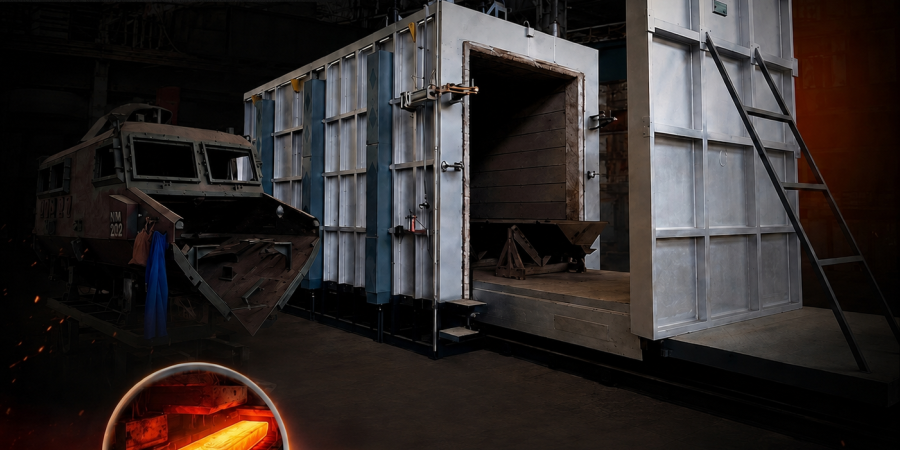
The quality of the treatment depends not only on the process parameters but also on the furnace used to perform the operation.
A suitable stress relieving furnace should provide controlled temperature operation and sufficient temperature uniformity throughout the working chamber. This becomes particularly important when treating large, heavy, or complex components.
Important furnace considerations include:
- Working chamber dimensions
- Maximum operating temperature
- Temperature uniformity
- Heating system
- Temperature control accuracy
- Insulation quality
- Loading arrangement
- Cooling requirements
- Temperature data recording
- Monitoring and control systems
- Component weight and dimensions
For large industrial components, furnace design is especially important because temperature differences across the load can affect treatment consistency.
A properly designed furnace can help maintain the required thermal conditions throughout the treatment cycle and support repeatable processing.
Applications of Stress Relieving Heat Treatment
The process is used across a wide range of manufacturing and engineering applications where residual stress and dimensional stability are important considerations.
Common applications include:
- Welded steel structures
- Heavy fabricated components
- Machinery parts
- Industrial equipment
- Pressure-related equipment
- Large machined components
- Automotive and engineering components
- Fabricated assemblies
- Components requiring dimensional stability
- Heavy-duty industrial structures
The appropriate process parameters should always be selected according to the material, component design, applicable standards, and intended application.
How Manufacturers Can Get Better Results
Successful stress relief is not simply about placing a component inside a furnace and increasing the temperature. The entire thermal cycle needs to be planned according to the characteristics of the component.
Manufacturers should evaluate:
- Material grade
- Component geometry
- Material thickness
- Previous manufacturing processes
- Required dimensional accuracy
- Heating rate
- Holding temperature
- Holding duration
- Cooling conditions
- Furnace loading arrangement
Proper loading is also important. Components should be positioned so that heat can circulate effectively and the furnace can achieve the required temperature distribution.
Temperature monitoring and recording can provide additional confidence that the intended cycle has been followed correctly. Consistent documentation can also help manufacturers maintain process repeatability across production batches.
Selecting the Appropriate Heat Treatment Equipment
A key component of achieving reliable results is choosing the right equipment.
The size and weight of the components, required operating temperature, production volume, heating technique, temperature uniformity requirements, and available loading system should all be considered when selecting the furnace.
A furnace with a suitable working chamber size and dependable temperature control can simplify the process for companies handling large fabricated structures.
Additionally, instead of selecting a conventional configuration without considering component dimensions and process conditions, the equipment should be tailored to the actual production requirements.
Conclusion
Stress relieving heat treatment plays an important role in managing residual stresses created during manufacturing. For welded, machined, formed, and fabricated metal components, controlling these stresses can help improve dimensional stability and make subsequent manufacturing operations more predictable.
The right approach depends on the material, component design, manufacturing history, required tolerances, and intended application. The furnace used for the process should also be capable of providing controlled and uniform heating for the size and type of components being treated.
For manufacturers working with heavy fabrications and industrial metal components, properly planned stress relief can become a valuable part of a controlled production process.
JR Furnace & Ovens provides industrial furnace and oven solutions designed around different heat treatment and manufacturing requirements. Furnace configurations can be selected according to component dimensions, operating temperature, production requirements, loading conditions, and process needs.
FAQ
What is stress relieving heat treatment used for?
Stress relieving heat treatment is mainly used to reduce residual stresses created during processes such as welding, machining, forming, casting, and fabrication. It can help improve dimensional stability and make subsequent manufacturing operations more predictable.
Is stress relieving required after welding?
Not every welded component requires stress relieving. The requirement depends on the material, component design, thickness, applicable standards, welding procedure, and intended service conditions.
Can stress relieving improve machining accuracy?
It can help reduce dimensional movement caused by the redistribution of residual stresses during machining. This can be particularly useful for large or precision-machined components.
What furnace is used for stress relieving?
A suitable industrial furnace should provide controlled heating, adequate temperature uniformity, appropriate chamber dimensions, and reliable monitoring for the required treatment cycle. The furnace configuration should be selected according to the component and process requirements.