
In manufacturing, metal components frequently require more than just the proper size and shape. To function dependably under challenging circumstances, they also require the proper balance of hardness, strength, toughness, ductility, and wear resistance. This is where heat treatment becomes important.
Heat treatment denotes a controlled process, involving heating, holding at temperature, and cooling a metal to obtain desired properties. While the process may appear simple, the heating temperature, holding time, cooling rate, or furnace atmosphere can have a significant impact on the material.
There are several types of heat treatment, and it is determined by the material and its intended use. This includes various processes that can help improve the workability of metals or make their surface harder.
What Is Heat Treatment?
Heat treatment is a thermal process used to modify the internal structure and mechanical properties of metals and alloys without changing their basic shape. The different types of heat treatment are selected according to the properties required for the finished component.
A typical heat treatment cycle involves three main stages:
- The material is heated to the appropriate temperature.
- Holding it at that temperature for a controlled period.
- Cooling it at a selected rate and under suitable conditions.
The technology is selected according to the material, the shape and size of the parts, and their intended use after processing.
For example, for one part, it is necessary to increase plasticity and reduce hardness, and for another one, on the contrary, hardenability is needed to make parts resistant to friction.
Why Is Heat Treatment Important in Industry?
The parts that have been manufactured undergo extreme pressure, friction, shocks, vibrations, and temperature gradients during operation. The right types of heat treatment can help improve the performance and durability of steel components by minimizing the effects of these factors.
Depending on the process, heat treatment can help:
- Increase hardness and strength
- Improve toughness
- Reduce internal stresses
- Improve ductility
- Increase wear resistance
- Improve machinability
- Refine the material structure
- Improve dimensional stability
The right treatment can therefore have a direct effect on component performance, service life, and manufacturing quality.
Major Types of Heat Treatment
Understanding the different types of heat treatment helps manufacturers select a process that matches the required material properties.
1. Annealing
Annealing is one of the commonly used types of heat treatment for improving ductility and machinability
The primary objective of the process is to reduce the hardness and increase the ductility of the material. The process also helps to remove internal tensions and consequently make the material simpler to machine and shape.
Industrial applications:
Annealing is commonly used for steel sheets, fabricated components, wires, tubes, and parts that have undergone cold working or other manufacturing operations. It is also used for selected aluminium and copper alloys.
For manufacturers dealing with large batches or components requiring consistent heating, furnace temperature uniformity is particularly important during annealing.
2. Normalizing
Normalizing is primarily associated with steel. The work piece is heated to a temperature higher than critical and then cooled in air.
This refines the structure of the material making it more homogeneous. It improves hardenability and toughness and prepares the metal for further machining or heat treatment.
Industrial applications:
Normalizing is often used for forged parts, cast components, structural steel products, shafts, gears, and other engineering components where a more consistent internal structure is required.
3. Hardening
Hardening is one of the widely used types of heat treatment for steel components that require increased hardness and strength.
The material is heated to the required temperature and then cooled rapidly through a suitable quenching process. The choice of quenching method depends on the steel grade, component geometry, and required properties.
Industrial applications:
Hardened components are commonly found in tools, machine parts, shafts, gears, dies, and components that experience wear or high mechanical loads.
However, increasing hardness can also increase brittleness. For this reason, tempering frequently comes after hardening.
4. Tempering
Tempering is generally performed after hardening. The hardened component is reheated to a controlled temperature below its critical range and then cooled.
The purpose is to reduce excessive brittleness while achieving a useful balance between hardness and toughness.
Industrial applications:
Tempering is widely used for gears, shafts, tools, fasteners, springs, and other steel components where both strength and resistance to impact are important.
The final tempering temperature depends on the properties required for the particular application.
5. Stress Relieving
Manufacturing processes such as welding, machining, forming, and casting can leave residual stresses inside metal components. If these stresses are not controlled, they may contribute to distortion or dimensional changes during later operations.
Stress relieving uses controlled heating and cooling to reduce these internal stresses.
Industrial applications:
This process is useful for welded structures, fabricated assemblies, large machined components, pressure-related equipment, and parts where dimensional stability is important.
A suitable stress relieving furnace should provide consistent heating throughout the load to reduce temperature differences between different sections of the component.
6. Case Hardening
Case hardening is used when a component requires a hard, wear-resistant outer surface while retaining a comparatively tougher core.
Instead of making the entire component extremely hard, the treatment concentrates the desired properties near the surface.
Industrial applications:
Case hardening is commonly used for gears, shafts, pins, bushes, and other components that experience repeated surface contact, friction, or wear.
Processes such as carburizing, nitriding, and carbonitriding can be used depending on the material and required surface properties.
7. Carburizing
Carburizing is a surface hardening process in which carbon is introduced into the surface of suitable low-carbon steel at an elevated temperature.
After the carbon-enrichment stage, the component may undergo hardening to develop a harder surface while maintaining a tougher core.
Industrial applications:
Carburizing is frequently used for gears, transmission components, shafts, and other machine parts that need good surface wear resistance along with core toughness.
8. Solution Annealing
Solution annealing is used for certain stainless steels and non-ferrous alloys. The material is heated to a suitable temperature to bring specific alloying elements into solid solution, followed by controlled cooling.
The treatment can help restore desired material properties and improve characteristics such as corrosion resistance and ductility, depending on the alloy.
Industrial applications:
Solution annealing is used in selected stainless steel components, aluminum alloys, and other alloy systems used in engineering and manufacturing.
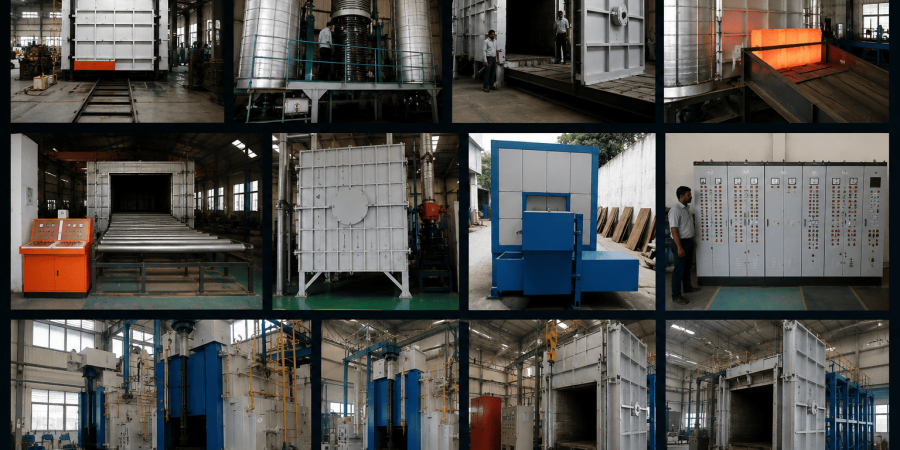
Types of Heat Treatment Furnaces
The furnace is an important part of any heat treatment operation because the quality of the final product depends heavily on temperature control and heating uniformity.
Common types of heat treatment furnaces include:
- Box furnaces
- Bogie hearth furnaces
- Bell annealing furnaces
- Gas-fired furnaces
- Electric furnaces
- Continuous furnaces
- Car bottom furnaces
The appropriate furnace depends on factors such as component dimensions, load weight, operating temperature, production volume, heating method, atmosphere requirements, and the treatment being performed.
For example, heavy and large components may require a bogie hearth furnace for convenient loading and unloading, while annealing operations may require a furnace designed specifically for controlled and uniform heating.
Heat Treatment Applications in Different Industries
The use of heat treatment extends across many manufacturing sectors.
Automotive Industry
Gears, shafts, axles, engine components, and other parts may require specific hardness and toughness levels to handle mechanical loads and repeated operation.
General Engineering
Machine components, tools, fasteners, fabricated parts, and precision components can undergo different treatments depending on their operating conditions.
Aerospace
Aerospace components often require carefully controlled material properties and consistent processing because reliability is critical.
Construction and Heavy Equipment
Large steel components used in heavy machinery and structural applications may require stress relieving, normalizing, hardening, or other treatments.
Energy and Industrial Equipment
Components used in power generation, processing equipment, and industrial machinery may require heat treatment to improve durability and resistance to demanding operating conditions.
How to Select the Right Heat Treatment Process
There is no single process that works for every metal component. The selection should begin with the material grade and the properties required in the finished product. Understanding the different types of heat treatment can help manufacturers choose the most suitable process for their specific application.
Consider the following factors:
Material: Different steel grades and alloys respond differently to heating and cooling.
Required properties: Decide whether the component needs hardness, toughness, ductility, wear resistance, machinability, or stress reduction.
Component size: Large or heavy parts may require different heating arrangements from small components.
Production volume: Batch production and continuous production can require different furnace configurations.
Temperature requirements: The furnace must be capable of reaching and maintaining the required process temperature with suitable uniformity.
Cooling requirements: The cooling method can have a major effect on the final properties, particularly during hardening.
Final Thoughts
The various types of heat treatment make it possible for manufacturers to adjust metals’ properties in the way that is necessary for them. Such properties as softness and machinability can be enhanced through annealing, normalizing helps to obtain the desired structure, hardening makes metals harder, while tempering brings brittleness and hardness to the optimal level. Stress relieving and case hardening eliminate other challenges associated with metalworking.
However, the choice of the proper heat treatment is not enough; it is necessary to ensure that the furnace will provide the required conditions for the selected process.
Therefore, when choosing the optimal heat-treatment process and the required furnace for the metal parts made in the organization, it is essential to consider the metals’ characteristics, the properties that are needed for a particular application, and all the requirements associated with these processes.
Frequently Asked Questions (FAQs)
1. What is heat treatment used for?
Heat treatment is used to change the properties of metal so it performs better in its intended application. Depending on the process, it can make a component harder, tougher, more ductile, easier to machine, or more resistant to wear and internal stress.
2. What are the most common types of heat treatment?
Some commonly used processes are annealing, normalizing, hardening, tempering, stress relieving, case hardening, carburizing, and solution annealing. The right process depends on the type of metal and the properties required from the finished component.
3. How does heat treatment improve metal components?
A properly selected heat treatment can improve the way a metal component handles load, friction, impact, and repeated use. It can also reduce internal stresses and help maintain better dimensional stability during service.
4. How is the right heat treatment furnace selected?
The furnace should match the material, component size, load weight, required temperature, production volume, and heating method. Large and heavy components, for example, may need a bogie hearth or car bottom furnace, while other applications may require a different furnace design.