
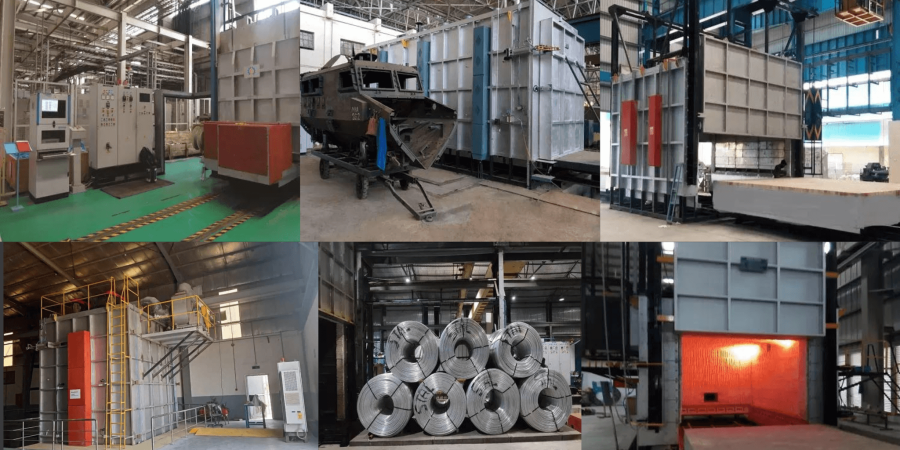
Handling massive industrial components is one of the biggest challenges in modern manufacturing. Heavy forgings, large castings, pressure vessels, and structural parts require precise heat treatment without distortion or damage. Traditional furnace systems struggle with such loads, especially when weight and size increase significantly.
A Bogie Hearth Furnace solves this problem with a powerful design that combines strength, flexibility, and precise temperature control. At JR Furnace, these furnaces are engineered to handle extremely heavy components while maintaining uniform heat treatment and operational safety.
What Makes Handling Massive Components Difficult?
Industries dealing with large components face several challenges:
- Extremely heavy loads (up to 200 MT or more)
- Irregular shapes and sizes
- Risk of uneven heating and thermal stress
- Difficulty in safe loading and unloading
- Need for consistent temperature across the entire component
A Bogie Hearth Furnace is designed specifically to overcome these challenges efficiently.
How a Bogie Hearth Furnace Works
A Bogie Hearth Furnace operates using a movable platform known as a bogie or car-bottom. This platform carries the load and moves in and out of the furnace chamber on rails.
Working Process
Loading
Heavy components are placed on the bogie outside the furnace using EOT cranes or lifting systems.
Movement
The bogie moves smoothly into the furnace chamber using a motorized mechanism.
Heating
The furnace heats the entire load uniformly using heating elements or burners placed strategically.
Soaking
The required temperature is maintained to ensure proper heat penetration.
Cooling
The components cool down in a controlled environment to achieve desired properties.
This process ensures safe and efficient handling of large industrial parts.
Key Features That Enable Handling of Massive Components
1. Retractable Bogie System
The bogie hearth furnace uses a wheeled platform that moves outside the furnace.
- Allows easy loading of heavy components
- Eliminates the need to handle materials inside a hot chamber
- Improves safety and efficiency
2. Heavy-Duty Structural Design
The furnace is built with a strong steel frame and reinforced insulation.
- Supports extremely heavy loads without bending
- Uses refractory bricks and ceramic fiber insulation
- Maintains structural stability at high temperatures
3. Motorized Movement Mechanism
The bogie moves using controlled systems such as:
- Rack and pinion drive
- Rope and drum mechanism
This ensures smooth and precise movement of heavy loads.
4. Flexible Loading Space
The furnace chamber is designed to handle:
- Large and bulky components
- Different shapes and configurations
- Multiple parts in a single batch
This flexibility makes it ideal for varied industrial applications.
How Temperature Uniformity Is Maintained
Uniform heating is critical when dealing with massive components. A bogie hearth furnace ensures this through:
- Heating elements placed on walls, roof, and sometimes the hearth
- Multi-zone heating systems
- Advanced temperature control systems
This results in:
- Even heat distribution
- Reduced thermal stress
- Consistent material properties
Advanced Control Systems for Precision
Modern furnaces from JR Furnace include advanced control features such as:
- Programmable temperature controllers
- PLC and SCADA systems
- Controlled heating, soaking, and cooling rates
- Data monitoring and recording
These systems ensure accuracy and repeatability in every cycle.
Safety Advantages in Handling Heavy Loads
Safety is a major concern in heat treatment operations. A bogie hearth furnace improves safety by:
- Allowing loading outside the hot zone
- Reducing operator exposure to high temperatures
- Providing controlled movement of heavy components
- Using proper sealing systems to prevent heat loss
Energy Efficiency and Performance
Despite handling large loads, these furnaces are designed for efficiency:
- High-quality insulation reduces heat loss
- Advanced burners and heating elements improve energy use
- Recuperators and regenerative systems enhance fuel efficiency
This results in lower operational costs and better performance.
Technical Specifications
A typical bogie hearth furnace offers:
- Temperature Range: Up to 1500°C
- Batch Capacity: Up to 200 MT
- Heating Options: Electric, Gas, or Oil-fired
- Heating Elements: Nichrome wire, alloy resistance wire, silicon carbide rods
- Insulation: Ceramic fiber blanket, modules, refractory bricks
- Control Systems: PLC, SCADA, HMI, temperature recorders
Applications of Bogie Hearth Furnaces
These furnaces are widely used in industries that handle large components:
- Heavy Engineering: Structural parts and large assemblies
- Automotive: Heavy-duty components and machinery parts
- Aerospace: Critical components requiring precise heat treatment
- Foundries: Large castings and molds
Heat Treatment Processes Supported
A bogie hearth furnace supports multiple processes, including:
- Annealing
- Stress relieving
- Hardening
- Tempering
- Normalizing
- Post weld heat treatment
- Case hardening
This makes it a versatile solution for industrial heat treatment.
Why Choose JR Furnace for Bogie Hearth Furnaces
JR Furnace designs high-performance furnaces that meet industrial standards and customer requirements.
Key benefits include:
- Strong and durable construction
- High temperature uniformity
- Flexible design for large components
- Advanced automation and control
- Reliable performance for long-term use
These features ensure efficient handling of massive industrial loads.