
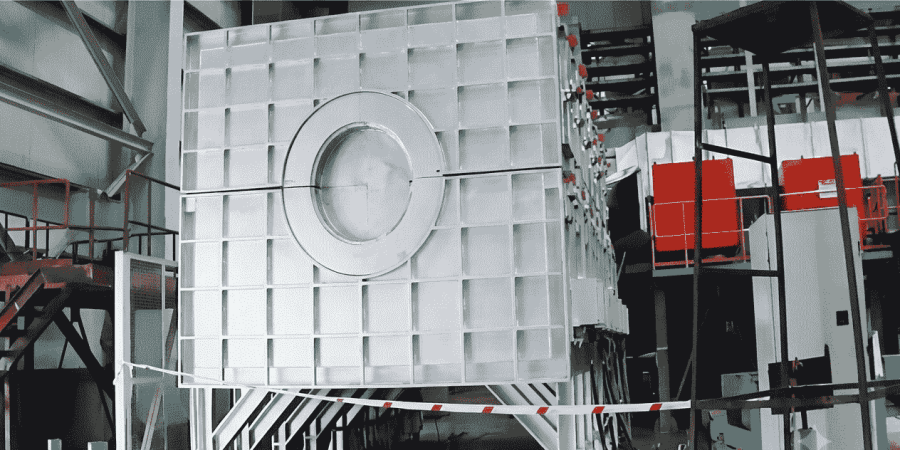
Although welding produces a strong, long-lasting bond between metal components, it also exposes the surrounding material to high, localized heat. The metal expands and compresses at varying speeds when the weld cools. Residual stresses and alterations in the microstructure surrounding the weld and heat-affected zone may result from this.
Just finishing the welding process might not be sufficient for parts utilized in harsh industrial settings. Before the welded component is put into operation, its condition can be improved and these effects can be managed by Post Weld Heat Treatment (PWHT).
Applications involving pressure vessels, boilers, pipes, heavy fabrication, power equipment, oil and gas equipment, and other components where dependability is crucial make the process especially crucial. PWHT may be necessary as part of the fabrication process, depending on the material, thickness, design specifications, and relevant code. PWHT is acknowledged by ASME as a crucial factor in the construction and inspection of pressure equipment.
What Is Post Weld Heat Treatment?
Post Weld Heat Treatment is a controlled heating, soaking and cooling process performed on a welded component after welding.
The component is heated according to a specified thermal cycle, maintained at the required temperature for a defined period, and then cooled under controlled conditions. The exact cycle is not the same for every material or application. It depends on factors such as material grade, thickness, weld configuration, service conditions and the applicable specification or construction code.
The main objective is to modify the condition of the welded area rather than simply make the weld “stronger.” Depending on the material and application, the treatment can reduce residual stresses, temper undesirable hard microstructures and improve the overall condition of the weld and heat-affected zone.
ISO 17663:2023 specifically provides quality requirements and guidance for heat treatment associated with welding, including post-weld heat treatment.
Why Is Post Weld Heat Treatment Necessary?
During welding, a relatively small area of the component reaches a very high temperature while the surrounding metal remains much cooler. Once the welding heat source moves away, the molten and heated material begins to cool and contract.
The surrounding material restricts this movement. As a result, internal stresses can remain locked inside the welded component.
In some steels, the welding thermal cycle can also create harder microstructures in the heat-affected zone. Depending on the material and service conditions, these changes can affect toughness and cracking susceptibility.
Post Weld Heat Treatment helps control these effects by exposing the component to a carefully controlled thermal cycle. For suitable materials, this can reduce residual stress and temper hard structures in the weld region. Technical guidance on PWHT also distinguishes between stress relieving of non-alloy steels and tempering treatments used for certain alloy and martensitic stainless steels.
The important point is that PWHT is not simply a matter of heating a welded part to a convenient temperature. The thermal cycle has to match the material and engineering requirements.
What Happens During the PWHT Process?
A typical Post Weld Heat Treatment cycle consists of controlled heating, soaking and cooling.
First, the welded component is heated gradually. The heating rate must be controlled so that excessive temperature differences do not develop within the component. Large temperature gradients can create additional thermal stresses, which defeats the purpose of carefully treating the weld.
Once the required temperature is reached, the component is held at that temperature for the specified period. This soaking stage allows the heat to penetrate the component and provides the required metallurgical effect.
After the holding period, the component is cooled according to the approved procedure. Cooling conditions are important because uncontrolled cooling can again introduce unwanted thermal stresses.
For this reason, industrial PWHT systems normally use temperature monitoring and recording equipment. The treatment record can provide evidence that the required heating, holding and cooling cycle was actually achieved.
How Does PWHT Reduce Residual Stress?
Residual stress is one of the main reasons Post Weld Heat Treatment is used in welded steel components.
Imagine welding a thick steel fabrication. The weld area becomes extremely hot and then cools. During cooling, the weld metal contracts, but the surrounding colder metal restricts that contraction. This produces internal stresses around the joint.
When the component is heated in a controlled manner during stress-relief treatment, the material’s yield strength decreases at elevated temperature. This allows some of the locked-in stresses to relax through controlled deformation.
The result is a lower residual-stress level than existed immediately after welding. PWHT does not normally eliminate every residual stress from a component, but it can significantly reduce the stresses when the correct procedure is applied.
This is particularly valuable for fabricated components that will later experience pressure, thermal cycling, vibration or other demanding service conditions.
Does PWHT Improve Weld Quality?
PWHT should not be considered a substitute for good welding practice.
A poor weld cannot simply be corrected by putting the component into a heat treatment furnace. Welding procedure qualification, suitable filler material, correct preheating, interpass temperature control, welder qualification and appropriate inspection all remain important.
What PWHT can do is improve the metallurgical condition of an acceptable welded joint where the treatment is required or technically justified.
For susceptible steels, the treatment can reduce excessive hardness and temper the heat-affected zone. It can also help reduce residual stresses associated with welding. These effects can contribute to improved service reliability.
That is why the decision to use PWHT should be based on the material, design and applicable requirements rather than applying the same thermal cycle to every welded component.
What Factors Determine the PWHT Temperature?
There is no single Post Weld Heat Treatment temperature that is correct for every weld.
The required temperature and holding time depend on the material and the applicable specification. Thickness can also influence the required holding period and thermal cycle.
For example, carbon and low-alloy steels may have different requirements from chromium-molybdenum steels or martensitic stainless steels. Some materials may also be sensitive to excessive heating because an unsuitable thermal cycle can negatively affect their mechanical or metallurgical properties.
The applicable construction code, material specification, welding procedure and customer requirements should therefore be reviewed before establishing a PWHT cycle.
ISO’s technical documentation makes the same distinction: recommendations for PWHT parameters depend on material and thickness, while the question of when PWHT is required is determined by relevant product standards, material specifications or other applicable requirements.
Furnace PWHT vs Local PWHT
The method used for Post Weld Heat Treatment depends largely on the size and configuration of the component.
For components that can be placed inside a suitable furnace, furnace-based treatment provides a controlled environment and can heat the component uniformly. This approach is useful for fabricated components that can be accommodated within the furnace working space.
Large pressure vessels, piping assemblies and structures that cannot be moved into a furnace may require localized heating. Resistance heating and induction heating are commonly used approaches for localized PWHT. ISO documentation recognizes furnace and local heating methods such as induction or resistance heating for PWHT applications.
The choice should consider component geometry, material, weld location, heating area, temperature uniformity, accessibility and the applicable procedure.
Where Is Post Weld Heat Treatment Used?
Post Weld Heat Treatment is commonly associated with demanding fabrication applications where welded components must maintain reliable performance during service.
Typical applications include pressure vessels, boilers, process piping, power-generation equipment, petrochemical equipment, storage and process systems, heavy engineering fabrications and other welded steel structures.
The importance becomes even greater when components operate under pressure, elevated temperature or cyclic loading, or when the material is susceptible to problems associated with residual stress and hard microstructures.
For manufacturers, proper PWHT is therefore not only a heating operation. It is part of the overall quality-control process surrounding welding and fabrication.
What Makes a Good PWHT System?
A reliable PWHT system needs more than a heating source.
Temperature uniformity is important because the component should experience the intended thermal cycle rather than large uncontrolled temperature differences. Accurate thermocouple placement and reliable temperature recording are also important for verifying the treatment.
The furnace or heating system should be selected according to the component dimensions, required operating temperature, heating capacity and production requirements.
For industrial applications, the system may also need suitable controls, data logging, safety systems and provisions for controlled heating and cooling.
At JR Furnace & Ovens, industrial heat treatment equipment can be engineered for applications where controlled temperature distribution, repeatability and production reliability are important. The right furnace configuration depends on the component dimensions, material, treatment cycle and production requirements.
Common Mistakes to Avoid During PWHT
One common mistake is assuming that every welded steel component needs the same heat treatment cycle. In practice, the material and applicable engineering requirements must be considered first.
Another mistake is focusing only on the soaking temperature while ignoring heating and cooling rates. A correct holding temperature does not automatically mean that the complete thermal cycle is correct.
Insufficient temperature monitoring is another concern. Without appropriate measurement and recording, it becomes difficult to demonstrate that the specified cycle was actually followed.
Finally, PWHT should not be treated as an isolated operation. Welding procedure, inspection, material certification and heat treatment records should work together as part of the overall fabrication-quality system.
Conclusion
Post Weld Heat Treatment plays an important role in controlling the effects created by welding. By applying a carefully controlled heating, soaking and cooling cycle, manufacturers can reduce residual stresses and, where appropriate, modify undesirable metallurgical conditions in the weld and heat-affected zone.
However, successful PWHT depends on much more than selecting a furnace temperature. Material grade, thickness, weld design, applicable codes, heating and cooling rates, holding time and temperature monitoring all need to be considered.
For industrial manufacturers, selecting the right PWHT equipment is equally important. A properly designed heat treatment system can provide the temperature control, uniformity and recording capability needed for repeatable production.
If your application involves pressure vessels, heavy fabrication, welded structures or other components requiring controlled thermal treatment, the PWHT cycle should always be established from the applicable engineering specification rather than a generic temperature rule.
Frequently Asked Questions
1. What is Post Weld Heat Treatment?
Post Weld Heat Treatment is a controlled heating and cooling process performed after welding. It is used, depending on the material and application, to reduce residual stresses and modify the metallurgical condition of the welded area.
2. Is PWHT required for every welded component?
No. PWHT is not automatically required for every weld. The requirement depends on factors such as material, thickness, design, service conditions and the applicable construction code or specification.
3. What is the purpose of PWHT?
The main purposes can include reducing residual welding stresses, tempering hard microstructures in susceptible materials and improving the condition and reliability of the welded component. The exact objective depends on the material and treatment procedure.
4. Can PWHT be performed without a furnace?
Yes. Depending on the component size and application, localized methods such as resistance or induction heating can be used when furnace treatment is not practical.