
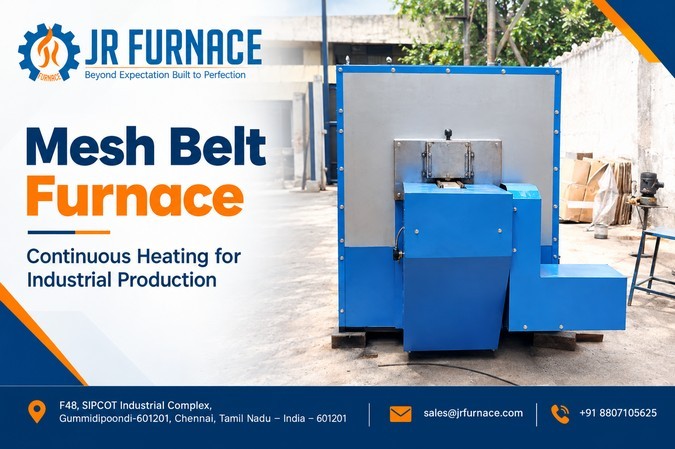
In metal manufacturing, maintaining consistent product quality while meeting production schedules is a daily challenge. A component may be small, but when thousands of similar parts need to be processed every day, the heat treatment process becomes an important part of the entire production operation. Manufacturers need equipment that can handle a steady flow of components without making the process unnecessarily complicated.
This is where a mesh belt furnace becomes useful. It allows metal components to move continuously through a controlled heating system instead of being loaded and unloaded in separate batches. For industries producing fasteners, automotive parts, bearings, and other small metal components, this arrangement can help maintain a more organised production flow.
A properly selected Belt-type furnace brings together controlled heating, continuous material movement, and suitable cooling arrangements. The actual results depend on the component material, heat treatment requirements, furnace design, and operating conditions.
For manufacturers looking to improve their production process, understanding how this furnace works and where it fits is an important first step.
What Is a Mesh Belt Furnace?
A mesh belt furnace is a continuous industrial heating system in which metal components travel through a heated chamber on a moving, heat-resistant metal mesh belt.
Unlike a conventional batch furnace, where a group of components is loaded into a chamber for a complete heating cycle, this system allows components to enter and leave the furnace continuously. The belt carries them through the required heating zones at a controlled speed.
The equipment can be designed for different heat treatment processes, depending on the materials and production requirements. Common applications include hardening, tempering, annealing, carburizing, and carbonitriding. Not every furnace configuration is suitable for every process, so the heating arrangement, atmosphere, and cooling system must be selected accordingly.
For production facilities handling large quantities of relatively small components, this arrangement provides a practical way to combine material handling with heat treatment.
How Does a Mesh Belt Furnace Work?
The working process is based on controlled movement and carefully managed heating conditions. Each component passes through the required stages according to the selected heat treatment cycle.
1. Loading and material movement
Metal components are placed onto the mesh belt at the furnace entrance. Depending on the production line, loading may be performed manually or through an automatic feeding arrangement.
The belt moves at a controlled speed, carrying the components into the heating chamber. Proper spacing and loading are important because overcrowding can affect heat transfer and lead to inconsistent treatment results.
2. Heating and temperature control
As the components enter the furnace, they gradually reach the required processing temperature. Heating may be provided through electric or gas-fired systems, depending on the furnace design.
The heating chamber may contain multiple temperature zones, allowing different sections to be controlled according to the required thermal cycle. The actual temperature and soaking time depend on the material grade, component dimensions, and intended metallurgical properties.
3. Controlled atmosphere processing
Some applications require a controlled atmosphere to reduce unwanted oxidation or surface decarburization. In other applications, the atmosphere may be selected to support processes such as carburizing or carbonitriding.
The atmosphere requirements must match the specific treatment process. Suitable gas monitoring and control arrangements help maintain the required operating conditions throughout production.
4. Cooling, quenching, and discharge
After heating, components move into the required cooling or quenching arrangement. Depending on the process, this may involve controlled cooling or a suitable quenching medium.
Once the treatment cycle is complete, the components are discharged for further operations such as cleaning, inspection, or tempering where required.
The complete arrangement may include additional equipment, such as washing systems and tempering furnaces, depending on the production requirements.
Industrial Applications of Mesh Belt Furnace
The usefulness of a mesh belt furnace depends largely on the type of components being manufactured and the quantity that needs to be processed. It is particularly relevant where similar parts are produced repeatedly and require a consistent heat treatment cycle.
Automotive component manufacturing
Automotive manufacturing involves a wide range of metal components that require specific combinations of hardness, strength, and wear resistance.
Depending on the design and process, mesh belt furnace systems can be used for suitable fasteners, pins, bushes, and other small automotive components. Controlled heating and cooling help manufacturers achieve the required metallurgical properties while maintaining a continuous production flow.
Fasteners and hardware production
Bolts, screws, nuts, and other fasteners are produced in large quantities across several industrial sectors. Their heat treatment requirements depend on the steel grade, component dimensions, and final application.
A mesh belt furnace can support continuous processing of suitable fasteners, reducing the need to handle each production batch separately. Controlled atmosphere treatment may also be used when surface condition and case hardening requirements call for it.
Bearing and engineering components
Certain bearing components and small engineering parts require carefully controlled heating and cooling to achieve their intended hardness and service properties.
A mesh belt furnace can be considered where component size, loading arrangement, and production volume are suitable for continuous processing.
For more complex or larger components, other furnace configurations may be more appropriate. Selecting the equipment according to the component geometry and treatment cycle is therefore essential.
Tools and small metal parts
Selected tools, clips, springs, stamped parts, and other small metal products can also be processed in continuous furnace systems.
The suitability of the equipment depends on the material, required temperature, component thickness, and whether the parts can be transported safely on the belt without damage or excessive movement.
Key Benefits of a Continuous Mesh Belt Furnace
The main reason manufacturers consider a Continuous belt furnace is the ability to coordinate heating with a steady production flow.
Continuous production
A moving belt allows components to enter and leave the furnace throughout the production cycle. This can make material movement easier to organise when the manufacturing process involves large quantities of similar parts.
Actual production capacity depends on belt width, loading density, belt speed, heating time, and the selected process.
Consistent processing conditions
Maintaining a suitable temperature profile and controlled belt speed helps ensure that components receive the intended thermal treatment.
Multi-zone temperature control can be used to manage the heating profile, while suitable atmosphere and cooling arrangements support the required process conditions. Consistency still depends on correct loading, calibration, maintenance, and process development.
Reduced manual handling
In a continuous production line, components can move between loading, heating, and discharge stages with less repeated batch handling.
This can simplify material movement and reduce the number of manual transfers required. The level of automation depends on the feeding, discharge, and control systems included in the furnace design.
Better production planning
Continuous processing allows manufacturers to plan material flow around a defined belt speed and treatment cycle.
For factories producing standardised components, this can help coordinate heat treatment with upstream manufacturing and downstream inspection or packaging operations.
However, the actual productivity improvement should be evaluated against the existing process, equipment capacity, energy consumption, and operating costs.
Factors to Consider When Selecting a Mesh Belt Furnace
Choosing a mesh belt involves more than comparing furnace dimensions or heating capacity. The equipment needs to match the actual production requirement.
The following points should be reviewed before selecting a system.
Selection factor | What to evaluate |
|---|---|
Material type | Steel grade, alloy composition, and material condition |
Component dimensions | Size, shape, weight, and loading arrangement |
Production capacity | Required output per hour or production shift |
Process temperature | Required heating temperature and soaking time |
Belt design | Belt material, width, loading weight, and operating conditions |
Atmosphere | Air or protective atmosphere requirements for the process |
Cooling system | Required cooling or quenching method |
Automation | Feeding, discharge, monitoring, and control requirements |
These factors influence the furnace configuration and the quality of the finished components.
For example, a production line designed for small fasteners may have different belt and loading requirements from a system handling larger stamped components. Similarly, a process requiring protective atmosphere control will need an appropriate chamber and atmosphere management arrangement.
Manufacturers should also consider access for maintenance, spare parts, operator safety, and the availability of technical support.
For a broader overview of industrial furnace selection, readers can refer to the JR Furnace Industrial Furnace Selection Guide .
Mesh Belt Furnace vs Roller Hearth Furnace
Both mesh belt and roller hearth furnace systems support continuous industrial processing, but they are designed around different material handling arrangements.
A belt furnace transports components on a moving metal mesh belt, making it suitable for many smaller parts that can be loaded directly onto the belt or arranged in suitable trays.
A roller hearth furnace uses rollers to move components or loads through the heating chamber. It is commonly considered for larger, heavier, or regularly shaped workpieces that can be supported and transported on rollers.
Feature | Mesh Belt Furnace | Roller Hearth Furnace |
|---|---|---|
Material movement | Moving mesh belt | Powered roller system |
Typical component suitability | Small parts and suitable bulk components | Larger or regularly shaped loads |
Loading approach | Direct belt loading or suitable trays | Components or loads supported on rollers |
Selection considerations | Belt loading, component size, and process | Workpiece dimensions, weight, and roller arrangement |
Neither configuration is suitable for every application. The right choice depends on the workpiece, production volume, heat treatment cycle, and material handling requirements.
For more information, read the JR Furnace Roller Hearth Furnace Selection and Operation Guide .
Frequently Asked Questions
1. What is a mesh belt furnace used for?
It is used for continuous heat treatment of suitable metal components. Common applications include hardening, tempering, annealing, carburizing, and carbonitriding, depending on the equipment configuration and process requirements.
2. How does a continuous mesh belt furnace work?
Components are loaded onto a moving metal belt that carries them through controlled heating zones. The belt speed, temperature profile, atmosphere, and cooling arrangement are selected according to the required treatment cycle.
3. Which industries use mesh belt furnaces?
It is used in applications involving automotive components, fasteners, bearings, hardware, and general engineering parts. Their suitability depends on component dimensions, material, production volume, and heat treatment requirements.
4. What should manufacturers consider before selecting a mesh belt furnace?
Manufacturers should evaluate component material, dimensions, production capacity, required temperature, belt design, atmosphere requirements, cooling arrangements, automation, and maintenance access before selecting the equipment.
Conclusion
A mesh belt furnace can be a practical solution for manufacturers who need continuous heat treatment of suitable metal components in large quantities. By combining controlled heating with continuous material movement, it helps integrate the heat treatment process into a structured production line.
The key to obtaining consistent results is selecting the right configuration for the actual component and treatment requirements. Temperature control, belt speed, loading conditions, atmosphere, and cooling all need to work together.
JR Furnace & Ovens (P) Ltd provides industrial furnace solutions for manufacturing applications. Companies evaluating heat treatment equipment can explore the JR Furnace Heat Treatment Furnace range and contact the team to discuss their specific requirements.