
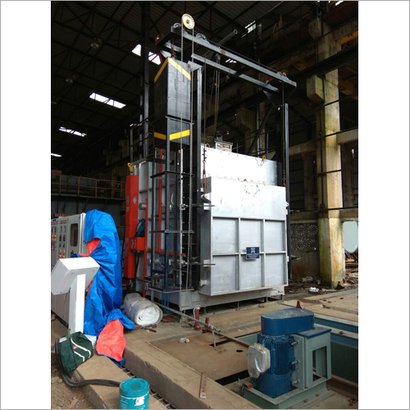
Rotary retort furnaces ensure uniform carburizing results by continuously tumbling parts inside a controlled atmosphere while maintaining stable temperature distribution. In real production, this makes a noticeable difference. I’ve seen carburized components from static batch setups show uneven case depth, while the same parts processed in a rotating retort come out far more consistent.
What actually happens is simple. When parts stay in one position, some surfaces receive more carbon exposure while others remain partially shielded. But in a rotary retort furnace, parts keep moving, rolling, and mixing. This constant motion allows heat and carbon-rich gases to reach every surface evenly, which helps achieve consistent metallurgical properties.
That’s exactly where a rotary retort furnace makes a big difference.
Let’s break this down in a practical way.
What Makes Rotary Retort Furnaces Different in Carburizing?
A rotary retort furnace works on a simple but powerful principle—continuous rotation. Instead of keeping parts static like in a batch furnace, it gently tumbles them inside a rotating tube.
What actually happens is:
- Parts keep moving and mixing
- Every surface gets exposed to heat and atmosphere
- No part stays hidden or insulated by others
This constant movement solves one of the biggest problems in carburizing—non-uniform carbon diffusion.
Why Uniform Carburizing Is Hard to Achieve
Before we talk about solutions, it’s important to understand the problem.
In carburizing, you want:
- Even carbon penetration
- Consistent case depth
- Uniform hardness across all parts
One common issue I’ve seen is parts at the bottom of a batch receiving less exposure to carbon-rich gases. The outer parts carburize properly, while inner parts lag behind.
Another issue is temperature variation within the load. Even small differences can change how carbon diffuses into the steel.
This is where rotary retort technology stands out.
Continuous Tumbling Ensures Equal Exposure
The biggest advantage of a rotary retort furnace is its tumbling action.
As the retort rotates:
- Parts continuously roll over each other
- Surfaces that were hidden become exposed
- Gas reaches all sides evenly
In real production, this makes a huge difference. I’ve seen processes where switching from static trays to rotary systems immediately improved case uniformity.
Instead of guessing whether gas reached every surface, you know it did—because the parts never stay in one position.
Uniform Temperature Distribution Inside the Retort
Temperature consistency is critical in carburizing. Carbon diffusion depends directly on temperature stability.
Rotary retort furnaces help in two ways:
- Constant movement reduces hot and cold spots
- Heat transfer improves due to continuous mixing
What actually happens is that parts don’t act as thermal barriers anymore. In static systems, tightly packed parts block heat flow. In a rotating retort, that problem disappears.
The result:
- Even heating across all parts
- Stable metallurgical transformation
- Reduced variation in hardness
Controlled Atmosphere Improves Carbon Transfer
Carburizing depends heavily on the furnace atmosphere.
Inside a rotary retort furnace, the retort acts as a sealed chamber. This allows precise control over:
- Carbon potential
- Gas composition
- Flow rate
But the real advantage comes from combining atmosphere control with rotation.
Here’s why:
- Gas continuously contacts fresh surfaces
- Carbon transfer becomes more consistent
- No localized depletion of carbon-rich gases
One issue I’ve seen in poorly controlled systems is uneven carbon potential across the load. Some areas get over-carburized, while others remain under-treated.
With a rotary system, that imbalance reduces significantly.
Controlled Residence Time Ensures Process Accuracy
Another important factor is how long parts stay inside the furnace.
In a rotary retort furnace:
- The retort is slightly inclined
- Rotation moves parts gradually from entry to exit
- Residence time remains predictable
This ensures:
- Every part gets the same exposure time
- No over-processing or under-processing
In batch furnaces, loading patterns can affect how long parts actually stay at temperature. In rotary systems, the process becomes more consistent.
Reduced Clustering and Part Shielding
One common issue I’ve seen during carburizing is part clustering.
When parts stick together:
- Inner surfaces don’t get proper exposure
- Carbon diffusion becomes uneven
The tumbling action in a rotary retort furnace prevents this:
- Parts keep separating
- Clusters break apart naturally
- Surfaces remain accessible
This directly improves:
- Case depth uniformity
- Surface hardness consistency
Improved Process Repeatability with Automation
Consistency is not just about one batch—it’s about repeating the same results every time.
Modern rotary retort furnaces use:
- PLC-based controls
- Automated temperature profiles
- Controlled gas flow systems
This ensures:
- Same cycle runs every time
- Minimal operator variation
- Reliable carburizing results
From experience, once a process is dialed in on a rotary system, it becomes much easier to maintain consistent output.
Where Rotary Retort Furnaces Work Best
These furnaces are not for every application, but they excel in specific scenarios.
They work best for:
- Small metal components
- Fasteners, pins, bushings
- High-volume production
- Parts that can handle tumbling
If you’re dealing with large or delicate components, this may not be the right option. But for bulk small parts, it’s one of the most reliable methods for uniform carburizing.
Common Mistakes That Still Affect Results
Even with a good furnace, problems can happen.
Here are a few I’ve seen:
- Incorrect rotation speed (too fast or too slow)
- Poor gas flow control
- Overloading the retort
- Inconsistent feed rate
A rotary system improves uniformity, but it still needs proper setup and monitoring.
How JR Furnace Supports Consistent Carburizing
From a practical standpoint, achieving uniform carburizing results depends on how well the system is engineered.
At JR Furnace, the focus stays on:
- Stable rotation mechanisms
- Proper sealing for atmosphere control
- Efficient heating and insulation
- Reliable automation systems
These factors ensure that carburizing processes remain consistent, even in demanding industrial environments.