
Stress Relieving Furnace
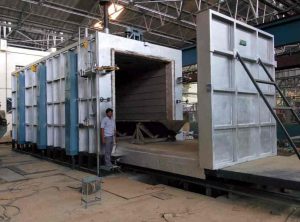
We are Stress Relieving Furnace Manufacturers in India. Components such as welded structures, cold drawn or formed items require stress relieving as stresses are induced in these processes which will deform the components after they are put in use. Our bogie hearth furnaces for stress relieving furnace or stress relief annealing are available with standard configuration as well as configurations custom for the user’s job profile and volume
Read More
Stress Relieving Furnace
Have you ever noticed metal parts bending or cracking after welding or machining?
Internal stress is often the hidden reason behind such failures. When metal components go through welding, cold drawing, forming, or machining, they develop internal stress. If you do not remove this stress before putting the parts into service, deformation or cracks may appear later. This is where a Stress Relieving Furnace plays a critical role in industrial heat treatment.
In heavy fabrication industries, manufacturers rely on advanced furnace systems to restore material stability. A well-designed system from JrFurnace ensures uniform heating, controlled cooling, and consistent stress removal for various metal components.
Why Internal Stress Develops in Metal Components
Before understanding how a furnace works, it is important to know why stress forms in the first place.
When metal undergoes:
- Welding
- Cold drawing
- Bending or forming
- Flame cutting
- Heavy machining
The structure of the material changes unevenly. Some areas expand or contract more than others. This creates internal tension inside the component.
If untreated, this stress can cause:
- Dimensional distortion
- Cracking
- Reduced fatigue life
- Structural weakness
Stress relief heat treatment removes these internal forces and improves the durability of the component.
How a Stress Relieving Furnace Works
A stress relieving process involves heating the component to a controlled temperature below its transformation point, holding it for a specific time, and cooling it gradually.
“Controlled heating and cooling ensure dimensional stability without changing the metal’s core structure.”
Unlike hardening or quenching, stress relieving does not significantly alter the material’s hardness. Instead, it improves internal balance.
The typical temperature range goes up to 900°C, depending on the material grade.
Technical Specifications at a Glance
Below is a clear overview of standard system capabilities:
| Parameter | Specification |
| Temperature Range | Up to 900°C |
| Power Capacity | 50 KW to 1500 KW |
| Batch Capacity | Up to 200 MT |
| Heating Media | Electric / Gas Fired / Oil Fired |
| Furnace Classification | Class 2 / Class 3 |
These specifications make the system suitable for both medium and large-scale industrial operations.
Heating Mechanism and Design Features
A properly engineered furnace ensures uniform temperature distribution across the entire load.
For Lower Temperature Stress Relieving (Up to 750°C)
- Centrifugal fan-based air circulation
- Stainless steel louvers
- Enhanced convective heat transfer
This design improves temperature uniformity at lower ranges.
For Higher Temperature Applications (Above 750°C)
- Radiation-based heating system
- No forced air circulation
- Uniform radiant heat distribution
This approach ensures stable heating without oxidation risks.
Insulation and Energy Efficiency
High-quality insulation reduces heat loss and saves energy. The system includes:
- Vacuum formed ceramic fibre boards
- Ceramic fibre blanket & modules
- Brick lining (as per requirement)
Proper insulation improves temperature accuracy and reduces operational costs.
Heating Elements and Control Systems
The heating elements used depend on temperature and process needs:
- Nichrome wire
- Special alloy resistance heating wire
- Silicon carbide rod type
For precision control, the furnace integrates:
- Thyristor control system
- Programmable temperature controller
- Temperature recorder
- PLC system
- SCADA monitoring
- HMI interface
This ensures accurate thermal cycles and repeatable results.
Industrial Applications
A Stress Relieving Furnace supports various industries. Its flexibility allows multiple heat treatment processes, including:
- Stress relieving
- Normalizing
- Tempering
- Preheating
- Annealing
Industries That Commonly Use It
- Oil and gas
- Steel fabrication
- Aerospace
- Automotive
- Heavy equipment manufacturing
Materials processed include:
- Carbon steel
- Alloy steel
- Stainless steel
- Aluminium
- Titanium
Door Sealing and Load Handling
Proper sealing prevents cold air from entering the chamber.
The furnace includes:
- Vertical lift doors
- Pneumatically operated soft seal clamps
- Bogie hearth load movement system
These features maintain temperature stability during the heating cycle.
Benefits of Using a Stress Relieving Furnace
Below are the major advantages:
- Improves dimensional stability
- Reduces risk of cracks
- Enhances fatigue strength
- Extends product life
- Maintains structural integrity
Investing in proper stress relief treatment reduces long-term repair costs.
Comparison of Heating Media Options
| Heating Media | Advantages | Suitable For |
| Electric | Clean, precise control | Medium capacity units |
| Gas Fired | Cost-effective for large loads | Heavy industries |
| Oil Fired | Reliable for remote areas | High volume processing |
Choosing the right heating method depends on plant infrastructure and load size.
Choosing the Right Furnace Configuration
Selecting the correct system depends on:
- Job profile
- Production volume
- Load dimensions
- Temperature requirement
- Industry standards
Some operations require standard configurations, while others demand customized systems to match specific component sizes and production flow.
Maintenance and Operational Safety
Regular maintenance improves furnace life and ensures consistent results.
Basic maintenance steps include:
- Checking heating elements
- Inspecting insulation
- Verifying temperature calibration
- Cleaning air circulation systems
- Monitoring PLC performance
Safety systems prevent overheating and ensure stable operation during long cycles.
Frequently Asked Questions
What temperature is used in stress relieving?
The temperature usually ranges between 450°C and 900°C depending on the material type.
Does stress relieving change hardness?
No, the process mainly removes internal stress without significantly affecting hardness.
How long does the process take?
The holding time depends on material thickness and grade. It may vary from one hour to several hours.
Can aluminium be stress relieved?
Yes, aluminium alloys can undergo stress relief at lower temperatures compared to steel.
Is air circulation necessary?
Air circulation is required for lower temperature ranges. For higher temperatures, radiation-based heating is sufficient.